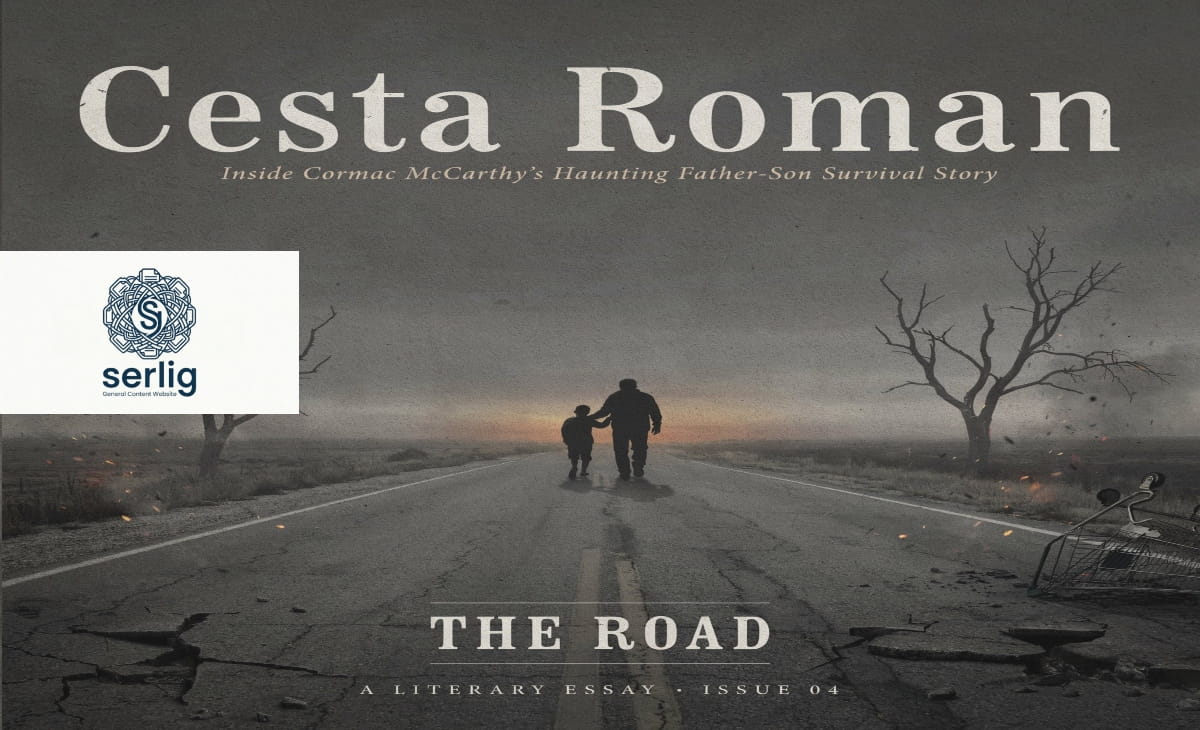
Cesta Roman: Inside Cormac McCarthy’s Haunting Father-Son Survival Story
Cesta Roman is the title that several Central and Eastern European editions use for Cormac McCarthy’s novel The Road. The word “roman” simply means “novel” in these languages. Publishers add it to clarify that “Cesta” refers to the book, not a literal road or a film. Croatian editions list it as “Cesta (roman).” Czech and Slovak editions publish it simply as “Cesta.” The story underneath stays the same in every language: a father and son walk through the ashes of civilization, and their bond becomes the only thing left worth protecting.
McCarthy published The Road in 2006. It quickly became one of the most acclaimed American novels of the century. The book won the Pulitzer Prize for Fiction in 2007 and the James Tait Black Memorial Prize in 2006. Oprah’s Book Club selected it, and a film adaptation followed in 2009. This guide breaks down the novel’s origins, plot, characters, themes, and lasting influence.
Quick Facts Table
| Detail | Information |
| Original title | The Road |
| Author | Cormac McCarthy |
| Published | 2006 |
| Genre | Post-apocalyptic fiction |
| Main characters | The Man, The Boy |
| Major awards | Pulitzer Prize for Fiction (2007), James Tait Black Memorial Prize (2006) |
| Film adaptation | 2009, directed by John Hillcoat |
| Lead actors (film) | Viggo Mortensen, Kodi Smit-McPhee |
Who Wrote The Road, and Why
Cormac McCarthy was an American novelist born in 1933. He wrote Blood Meridian, All the Pretty Horses, and No Country for Old Men before turning to The Road. Critics often compared his dense, sparse prose to William Faulkner’s style. He was 73 years old when he wrote this novel, already one of the most respected voices in American fiction.
The idea for The Road came from a personal moment. McCarthy has said he pictured the idea during a stay in El Paso, Texas. He imagined the city decades or centuries into the future, with fires burning on the hills and the landscape laid to waste. He thought of his young son, John Francis, as he pictured this scene. That image of a father and child alone in a ruined world stuck with him. The brief sketch eventually grew into a full novel, and McCarthy developed it further during a trip to Ireland before writing the book itself in a fairly short stretch of time.
Plot Summary of Cesta Roman
The Setting
The Road takes place years after an unnamed disaster destroys most of the planet. Textual clues suggest roughly a decade has passed. McCarthy never names the cause. Ash covers the sky permanently. Nearly all plant and animal life has died. The few human survivors face a world without food, warmth, or law.
The Journey South
Two unnamed characters drive the story forward: “the man” and “the boy.” They push a shopping cart loaded with their few possessions south along a desolate highway. They hope to reach the coast before another brutal winter arrives. The boy’s mother — called simply “the woman” — took her own life soon after his birth. She couldn’t face raising a child in this world. The man now protects his son alone.
Constant threats line the road. Starvation and exposure stalk the pair at every turn. Roving gangs of survivors do too — some have turned to violence and cannibalism to stay alive. The man and boy scavenge abandoned houses for canned food. They hide from other travelers and avoid being seen whenever they can. Several tense encounters punctuate their journey. They narrowly escape a house used by cannibals. They meet an old man named Ely. At one point, the man kills another traveler to protect his son.
The Father’s Final Days
The novel also holds moments of quiet kindness. The man teaches his son how to start fires and how to find food. He also teaches him to choose right over wrong, even when civilization’s rules no longer apply. Eventually, illness overtakes the man. He grows weaker each day. He hides the severity of his condition from his son for as long as he can, because he wants the boy to hold onto hope. In the final pages, the man dies. He tells his son to keep going and to keep “carrying the fire.” The boy mourns beside his father’s body for several days. A traveling family then finds him. They invite him to join them, offering a fragile note of continuation at the very end of an otherwise bleak story.
Main Characters in Cesta Roman
The Man drives the novel as its central figure. He stays resourceful and vigilant, and the duty of protecting his son consumes him completely. He takes extreme risks and makes difficult moral choices to keep the boy alive. His love for his son becomes the novel’s only remaining form of meaning.
The Boy is the man’s young son. The catastrophe struck around the time of his birth, so he has never known the old world. He represents both innocence and a kind of moral compass. He often pushes his father toward compassion, urging him to help other survivors they meet. McCarthy describes him as carrying “the fire,” a symbol of humanity and hope that his father urges him never to let go out.
The Woman, the boy’s mother, appears only in flashbacks. She chose to end her life rather than face the post-apocalyptic world. Her choice contrasts sharply with the man’s relentless will to continue, and it raises one of the novel’s central questions: what makes survival worth the struggle?
Ely, an old man the pair briefly meet, offers a moment of philosophical reflection on faith, mortality, and meaning in a world that has lost both God and society as anyone once knew them.
Major Themes in The Road
The novel explores how far people will go to protect their loved ones and themselves under extreme adversity. It also examines the moral choices survivors must navigate to stay alive. Several themes repeat throughout the book and give it emotional and philosophical weight.
Survival
The Road focuses heavily on the mechanics of staying alive: finding food, water, shelter, and warmth in a world that offers almost none of it. But McCarthy doesn’t limit survival to the physical. He explores psychological survival just as closely — what it costs a person to keep going when almost nothing remains to live for besides another person.
Love Between Parent and Child
The bond between the man and the boy forms the emotional core of the book. The father’s love isn’t sentimental in any conventional sense. It runs fierce, exhausted, and absolute, and he expresses it through constant vigilance rather than words. His love for his son drives every decision he makes, and he treats his son’s safety as an almost sacred duty worth risking his own life for.
Good Versus Evil
With law and society gone, the novel asks what still separates “good guys” from “bad guys” — if anything does. The cannibalistic gangs the pair encounter offer one answer: morality collapses entirely once survival is at stake. The man and boy represent the opposite stance. They stubbornly hold onto decency even when it offers no practical advantage.
Hope Against Despair
The book stays relentlessly grim, yet it resists total nihilism. Brief, sustaining flickers of hope cut through the pervasive bleakness throughout the story. Many readers and critics point to its ambiguous ending as evidence that McCarthy intended something more than pure despair.
Fire as a Symbol
Fire recurs constantly throughout the novel. Campfires offer warmth. The boy is shown a flare gun. He also supposedly carries a metaphorical “fire” inside him. This symbol stands for the survival of human goodness and conscience in a world that has otherwise gone dark.
The Road as a Symbol
The road itself represents both literal forward movement and a broader idea: life as a journey with no guarantee of arrival or reward. The man and boy must walk this passage regardless of what waits — or doesn’t wait — at its end.
Style and Structure
McCarthy writes The Road in famously spare prose. Short, simple sentences convey urgency and immediacy throughout the novel. He largely drops quotation marks and other conventional punctuation marks. He never names either main character. These choices reinforce a stripped-down, anonymized world where even language has been reduced to its essentials.
The narrative unfolds in short, often unconnected vignettes rather than conventional chapters. This structure mirrors the episodic, day-to-day nature of the characters’ survival. Occasional flashbacks interrupt the present-tense bleakness, showing the man’s memories of his wife and the world before the disaster — these moments offer brief, painful contrast.
Critical Reception and Cultural Impact
Critics met The Road with overwhelming acclaim upon release. Many now consider it one of the most significant American novels of its era. Critics like James Wood, Michael Chabon, and John Freeman praised McCarthy’s minimalist style and his depiction of a bleak, post-apocalyptic world. They also highlighted its underlying themes of love, despair, survival, and the essence of humanity. The 2007 Pulitzer Prize for Fiction cemented the book’s place in the literary canon. Oprah’s Book Club introduced it to an even wider popular readership.
The book has also taken on a life beyond literary criticism. Environmentalists have pointed to it as a warning about the dangers of pollution and climate change. Several churches have embraced its religious undertones. The novel’s ambiguity about its catastrophe lets very different audiences claim it for very different purposes — as ecological warning, parable, or character study.
John Hillcoat directed the 2009 film adaptation, with a screenplay by Joe Penhall. Viggo Mortensen played the man, and Kodi Smit-McPhee played the boy. The film brought the story to an even broader audience. Reviews stayed generally favorable, though many readers still consider the novel itself — with its spare prose and interior tension — the more powerful experience.
Conclusion
The Road — known as Cesta Roman in several Slavic-language editions — strips the post-apocalyptic genre down to its emotional essentials. The novel cares less about explaining the disaster than about asking a deeper question: what remains of a person, and of a relationship, once nearly everything else disappears? McCarthy finds something durable enough to carry meaning through total devastation. He finds it in the bond between the unnamed man and his son — the simple, stubborn act of caring for another person, even when no practical reason remains to do so. That stubborn act of care, not the road itself, forms the true heart of “Cesta.”
Explore more by reading this related post: Renteaza: Meaning, Usage, and Why This Romanian Word Matters in Everyday Life and Business
FAQs
What does Cesta Roman mean in the context of this novel?
Cesta Roman is the title used for Cormac McCarthy’s The Road in several Central and Eastern European languages, including Croatian, Czech, and Slovak. The word “roman” added in some editions simply means “novel” and helps distinguish the book from other things called “Cesta.”
What is The Road Cesta Roman about?
The novel follows an unnamed father and son as they travel south through a post-apocalyptic America, searching for safety and warmth while avoiding starvation and dangerous survivors.
Did The Road win any awards?
Yes. The novel won the Pulitzer Prize for Fiction in 2007 and the James Tait Black Memorial Prize in 2006. Oprah’s Book Club also selected it.
Is there a movie based on The Road?
Yes. A film adaptation released in 2009, directed by John Hillcoat and starring Viggo Mortensen and Kodi Smit-McPhee as the father and son.
What caused the apocalypse in The Road?
McCarthy never explains the cause directly. The novel only hints at a catastrophic, unnamed event that destroyed most plant and animal life and left the sky permanently covered in ash.