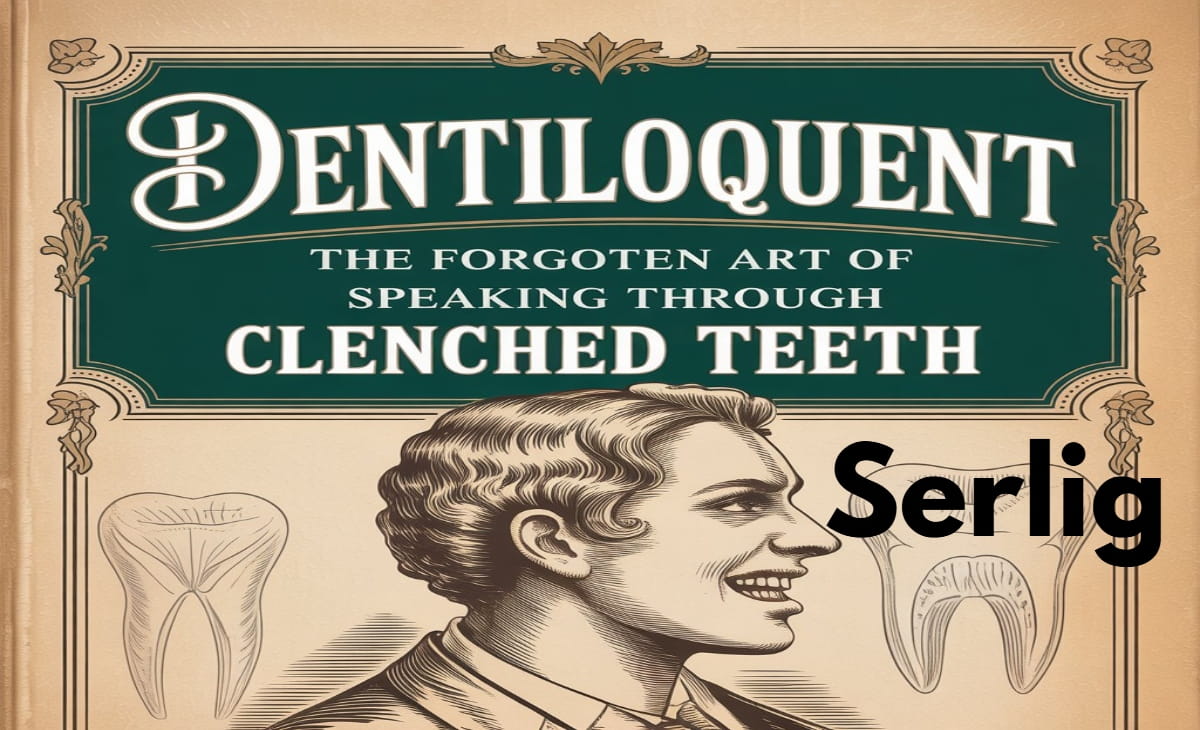
Dentiloquent: The Forgotten Art of Speaking Through Clenched Teeth
Some words do something the moment you read them. Dentiloquent is one of those words.
You have almost certainly witnessed dentiloquent speech — probably many times. The colleague who responds to bad news through barely parted lips. The character in a thriller who delivers a threat in a controlled, jaw-locked hiss. The athlete pushing through exhaustion who forces words out through clenched teeth. The person at a dinner table who maintains a fixed smile while their voice comes out tight, hard, and clipped.
You have seen it. You have possibly done it. Until now, you may not have had the precise word for it.
This guide covers everything: the verified meaning and etymology, the phonetics, the psychology, the medical dimension most articles miss, the literary and cinematic tradition, and exactly how and when to use the word well.
Quick Reference
| Detail | Information |
| Word | Dentiloquent |
| Part of Speech | Adjective |
| Pronunciation | den-TIL-oh-kwent |
| Meaning | Speaking with the teeth closed or nearly closed; talking through clenched teeth |
| Related Noun | Dentiloquy (the act or habit of speaking through clenched teeth) |
| Related Person Noun | Dentiloquist (a person who speaks in this manner) |
| Latin Roots | Dens/dentis (tooth) + loqui (to speak) |
| Word Family | Ventriloquist, eloquent, grandiloquent, magniloquent, breviloquent |
| Register | Formal, literary, medical/clinical |
| Status | Rare but legitimate — appears in historical dictionaries and linguistic texts |
What Does Dentiloquent Mean?
Dentiloquent (adjective) means: speaking with the teeth closed or nearly closed — talking through clenched or gritted teeth.
A dentiloquent speaker does not open their jaw properly. Words emerge from behind a tight, barely parted jaw, filtered through the teeth. The result is speech that sounds muffled, clipped, controlled, and emotionally charged — because clenching the jaw is almost never a neutral act.
The word dentiloquent refers to speaking through clenched teeth. When a person talks this way, their voice often sounds tight or controlled. In each case, the message sounds normal, but the tone tells something deeper.
The related noun form dentiloquy refers to the act or habit of speaking through clenched teeth. A dentiloquist is a person who speaks in this manner. Although these terms are rarely used today, they demonstrate how classical language influenced the development of English vocabulary.
The Latin Roots: Where Dentiloquent Comes From
Dens / Dentis — The Tooth Root
The first half of dentiloquent comes from the Latin dens (nominative) or dentis (genitive), meaning tooth. This root runs through dozens of common English words: dental, dentist, denture, dentition, and indent all carry it.
Even dandelion traces back here — from Old French dent-de-lion, meaning “lion’s tooth,” named for the plant’s jagged leaves. In Latin thought, the tooth represented precision, bite, and sharpness.
Loqui — The Speech Root
The second half comes from loqui, the Latin verb meaning to speak or to say. This root is equally productive in English: eloquent, loquacious, soliloquy, ventriloquist, colloquial, grandiloquent, and obloquy all descend from it.
Together: tooth + speak = dentiloquent. The word literally means tooth-speaking — and the word itself demands a small, precise movement of the mouth to pronounce correctly. That symmetry feels fitting.
The Full “-loquent” Family
Linguists classify dentiloquent as one of several rare “-loquents,” alongside words like melliloquent (speaking sweetly), grandiloquent (speaking pompously), and breviloquent (speaking briefly). Each word pins down a specific quality of speech. Dentiloquent pins down the most physical one of all: where in the mouth the words originate, and what that positioning communicates about the speaker’s inner state.
What Dentiloquent Speech Actually Sounds Like: The Phonetics
Dentiloquent speech has a distinctive and recognizable acoustic quality that phoneticians can describe precisely.
When the jaw clamps shut, dental and alveolar consonants — sounds formed near or at the teeth — become sharper and more constrained. These include /t/, /d/, /s/, /z/, /n/, and /l/. Vowels flatten and restrict. The voice takes on a pressurized quality, as though the speaker is containing something larger than the words themselves.
The mouth, in dentiloquent speech, becomes a closed system with pressure building behind it. Consonants grow harder and more percussive. The effect is tense, deliberate, and impossible to ignore.
Think of the difference between saying “I’m fine” with a relaxed jaw versus saying the same two words through gritted teeth. The words are identical. The meaning is opposite.
The Psychology: Why People Speak Through Clenched Teeth
Dentiloquent speech is rarely an accident. It maps onto specific emotional and physiological states with remarkable consistency.
Suppressed Anger — The Most Common Cause
Suppressed anger drives dentiloquent speech more than any other emotional state. When someone feels furious but cannot show it in a given context — a professional meeting, a family dinner, a public setting — the jaw locks as a containment mechanism. The anger seeps out through the teeth instead of through volume or expression.
Someone who must remain professional while feeling irritated or upset may respond calmly but with teeth clenched. The resulting speech becomes tight and controlled, reflecting the emotional tension beneath the surface.
“I told you not to do that,” whispered through a clenched jaw, carries more weight than the same words shouted. The dentiloquent delivery is often more frightening precisely because it signals control over a force that barely stays restrained.
Pain and Grief
Physical or emotional pain tightens the jaw as a reflex. The body under stress clamps down. Soldiers enduring injuries speak through clenched teeth in film — because that is what people actually do. Absorbing genuinely bad news produces the same response: the mouth cannot fully open under the weight of what the body is processing.
Extreme Cold
Cold produces a physiological version of dentiloquent speech that has nothing to do with emotion. When body temperature drops, the jaw tightens to conserve heat. The clenching is involuntary, driven by survival instinct. The acoustic result is identical to emotionally motivated dentiloquence — but the cause is entirely physical.
Determination and Grit
Athletes sometimes speak through their teeth during intense physical effort. In these situations, the expression reflects focus rather than anger. The clenched jaw becomes a physical embodiment of willpower — the face setting itself into resolve the way a fist closes before a difficult task.
Habitual Speech Patterns
Various factors can contribute to habitual dentiloquent speech patterns. Stress is one common cause — when individuals are under pressure, they often tense their jaws unconsciously. Teeth misalignment (malocclusion) can create discomfort that leads to restricted speech. Bruxism (teeth grinding) plays a role too — individuals who grind their teeth may develop limited jaw mobility. Additionally, temporomandibular joint disorder (TMJ) can affect jaw movement and further complicate communication.
For habitual dentiloquent speakers, the pattern is not an emotional state but a physical baseline — shaped by years of tension, dental issues, or structural jaw conditions.
The Medical Dimension: When Dentiloquent Speech Signals Something More
This is the angle most articles on dentiloquent miss — and it matters.
Bruxism and Its Speech Effects
Bruxism, commonly known as teeth grinding, can have a profound impact on an individual’s speech and communication abilities. The constant pressure and movement involved in grinding teeth can affect the alignment of the jaw and the muscles surrounding it, which are crucial for proper articulation and enunciation.
When bruxism goes untreated, it often leads to temporomandibular joint disorders (TMD) — a group of conditions that affect the jaw joint and surrounding muscles. TMD symptoms often show up as jaw clicking, popping, stiffness, or limited movement. If the jaw gets stuck or makes noises when talking, it likely is not functioning properly, which can interfere with natural speech flow.
TMJ Disorders and Speech
Research studies confirm that TMJ internal derangements alter the speech motions of patients compared to asymptomatic control subjects — demonstrating that jaw joint health directly affects how speech is physically produced.
Jaw pain from TMD can make a person less likely to open their mouth fully or move it with ease. This reduced mobility leads to speech that may sound quiet, flat, or mumbled. Some people describe the sensation as “talking through tension,” where every word feels physically harder to produce. This is especially common in the morning after a night of sleep bruxism, or after long periods of concentration or stress.
When to Seek Assessment
If dentiloquent speech is habitual rather than situational — particularly if accompanied by jaw pain, clicking, headaches at the temples, or soreness on waking — it may indicate an underlying condition worth professional assessment. A dentist or oral and maxillofacial specialist can evaluate jaw alignment, bruxism patterns, and TMJ function. The good news is that TMJ-related speech issues caused by bruxism are treatable. The sooner the connection between jaw discomfort and speech is recognized, the sooner relief becomes possible.
In clinical and medical writing, dentiloquent is a precise, useful descriptor — more specific than “muffled speech” or “restricted articulation,” and it locates the mechanism exactly.
Dentiloquent in Literature and Drama
The clenched-jaw speaker is one of storytelling’s most reliable figures. Writers and actors have understood its power for centuries.
Hemingway’s Compressed Prose
Ernest Hemingway is the literary master of implied dentiloquence. His characters communicate in short, controlled bursts. Dialogue strips away elaboration. Sentences feel forced through a constriction.
His iceberg theory — that meaning lives beneath the surface of what characters say — translates the aesthetics of dentiloquent speech into prose style. His characters do not explain their pain. They compress it and push it out in hard, small words. The reader feels the clenched jaw in the rhythm of the prose itself.
Film and the Actor’s Toolkit
In theater and film, clenched-jaw delivery is a reliable and teachable technique. Method actors speak about “holding emotion in the body” to generate authentic tension — and locking the jaw is one of the most visceral ways to achieve this.
Marlon Brando, Clint Eastwood, and Anthony Hopkins share a quality: extraordinary economy of speech. Their words carry weight because they hold them tightly before releasing them. Clint Eastwood’s Man with No Name in Sergio Leone’s Spaghetti Westerns may be cinema’s most famous dentiloquent figure. Minimal dialogue. Jaw set. Words arrive like bullets — few, targeted, and irrevocable.
The Ventriloquist Connection
Ventriloquist is dentiloquent’s more famous cousin. A ventriloquist — from venter (belly) and loqui (to speak) — appears to speak from the stomach while keeping their own mouth still.
Ventriloquism is the extreme end of the dentiloquent spectrum: speaking while barely moving the lips or jaw at all. Professional ventriloquists train for years to suppress jaw and lip movement while producing clear, intelligible speech. They are, in the most literal sense, masters of dentiloquent technique taken to its absolute limit.
Dentiloquent is the broad category. Ventriloquism is its extreme sport.
Why English Needs This Word
English already has mumble, mutter, hiss, growl, and snarl to describe unusual speech delivery. What does dentiloquent add?
Precision. Instead of writing “he spoke angrily through gritted teeth,” one word — dentiloquent — captures the entire image. It does not just describe sound; it conveys posture, tone, and mood simultaneously.
Mumble implies carelessness or failure at communication. Hiss and snarl carry animal connotations that may not fit the moment. Dentiloquent is neutral and clinical — it identifies how someone speaks without judging why. It is the difference between “crying,” “weeping,” and “sobbing”: each occupies a distinct register, and the specificity is the point.
Dentiloquent also locates the mechanism precisely — the teeth — making it valuable in medical contexts (describing restricted post-surgical speech), in linguistic analysis, in theatrical direction, and in careful literary writing.
How to Use Dentiloquent: Examples in Context
Here are six examples showing dentiloquent used effectively across different registers:
Literary / narrative: “His dentiloquent reply — barely three words through a jaw set like concrete — told her everything she needed to know about how this conversation would end.”
Medical / clinical: “The neurologist noted her dentiloquent speech following the procedure as consistent with temporomandibular joint tension and restricted mandibular mobility.”
Film / theatrical direction: “Deliver the line dentiloquently — let the audience feel that the anger is barely contained.”
Character description: “He carried that dentiloquent delivery of old noir detectives: words arriving clipped, hard, and unwilling to be wasted on anyone who hadn’t earned them.”
Ironic / social observation: “She answered with perfect dentiloquent pleasantness — wide fixed smile, teeth firmly together — a performance that convinced no one in the room.”
Psychological analysis: “The dentiloquent quality of his speech during the interview — the controlled jaw, the pressurized consonants — suggested suppressed anger far more clearly than his words did.”
Dentiloquent vs. Similar Words: Precise Distinctions
| Word | Meaning | Key Distinction |
| Dentiloquent | Speaking through clenched/closed teeth | Locates the mechanism precisely — the teeth; neutral, no judgment on quality |
| Mumble | Speaking unclearly, inaudibly | Implies failure or carelessness in communication |
| Mutter | Speaking quietly, often with discontent | Implies low volume and dissatisfaction, not jaw position |
| Hiss | Sharp, sibilant speech | Animal connotation; focuses on the sound, not the jaw mechanics |
| Growl | Low, threatening speech | Animal connotation; focuses on vocal quality, not dental position |
| Ventriloquism | Speaking without visible lip/jaw movement | The extreme form — dentiloquent taken to its maximum |
Frequently Asked Questions
What does dentiloquent mean?
Dentiloquent is an adjective meaning speaking with the teeth closed or nearly closed — talking through clenched or gritted teeth. It produces muffled, tight, clipped speech because the jaw stays nearly shut during speech. The related noun is dentiloquy; the person noun is dentiloquist.
Where does the word dentiloquent come from?
It comes from two Latin roots: dens (or dentis), meaning tooth, and loqui, meaning to speak. Combined, they literally mean “tooth-speaking.” The word belongs to the same Latin family as eloquent, loquacious, ventriloquist, grandiloquent, and soliloquy.
Is dentiloquent a real English word?
Yes. Dentiloquent is a legitimate English word with a genuine Latin etymology, a precise definition, and documented use in historical dictionaries and linguistic texts. It is rare but not invented. It has valid applications in descriptive writing, medical contexts, phonetics, and theatrical direction.
What causes someone to speak dentiloquently?
The most common causes are suppressed anger (the jaw locks to contain emotion), physical or emotional pain (a reflexive tightening), extreme cold (involuntary jaw clenching to conserve heat), and intense determination or grit. Habitual dentiloquent speech can also result from bruxism (teeth grinding), temporomandibular joint disorder (TMJ/TMD), chronic stress, or dental misalignment.
How is dentiloquent different from mumbling?
Mumbling implies unclear or careless speech — the speaker fails to communicate properly. Dentiloquent describes the specific physical mechanism of speaking through clenched teeth, with no judgment about communication quality. A dentiloquent speaker can be perfectly articulate. The word describes jaw position, not speech success or failure.
Can dentiloquent speech indicate a medical condition?
Yes. When dentiloquent speech is habitual rather than situational — especially if accompanied by jaw pain, clicking sounds, morning soreness, or headaches — it may indicate bruxism or temporomandibular joint disorder (TMJ/TMD). These conditions are treatable. A dentist or oral specialist can assess jaw alignment and function.
How do you pronounce dentiloquent?
den-TIL-oh-kwent. The stress falls on the second syllable: til. Say it aloud — the word itself requires a small, controlled movement of the mouth to pronounce correctly.
If this topic interests you, here’s another helpful article: Nicklar: Meaning, Uses, and Why This Emerging Term Is Trending in 2026
The Bottom Line
English grows richest when speakers draw on its full vocabulary. Dentiloquent earns its place because it does something no commonly used word does: it names a specific, emotionally loaded, physically precise mode of human speech with a single elegant term.
At first glance, dentiloquent might seem like an archaic curiosity, but it has unique advantages. Precision: instead of writing “he spoke angrily through gritted teeth,” one word captures the entire image. Literary flair: writers seek rare words that add freshness to their work. Emotional depth: it does not just describe sound; it conveys posture, tone, and mood simultaneously.
It also has a medical dimension that most word-enthusiast articles overlook entirely: habitual dentiloquent speech can signal bruxism, TMJ disorder, or chronic stress — conditions that are identifiable and treatable once named.
Having the word is, as any lover of language knows, its own small form of power.