Oronsuuts Explained: The Complete Guide to Mongolia’s Urban Apartment Housing System
If you searched for Oronsuuts and aren’t sure what it means, you’re not alone. The word appears in housing listings, real estate articles, academic papers, and government reports — often without explanation.
This guide answers every question you might have: what Oronsuuts means, where it came from, how it works, what it costs to rent or buy in 2026, who lives in it, what its challenges are, and where Mongolia’s urban housing is heading. Whether you’re researching Mongolian culture, considering a move to Ulaanbaatar, or simply curious about a word you spotted online — this is the guide for you.
Quick Reference
| Detail | Information |
| Word | Oronsuuts (орон сууц in Mongolian Cyrillic) |
| Pronunciation | oh-ron soots |
| Meaning | Residential housing / apartment |
| Primary Location | Ulaanbaatar, Mongolia (also Darkhan, Erdenet, other cities) |
| Population in Apartments | Over 1.3 million people across Mongolia |
| Ulaanbaatar Apartment Share | ~56% of city residents live in apartments |
| Average Rent (1-bed, city centre) | ~$421/month (2026) |
| Average Cost of Living (single person) | ~$617/month excluding rent (2026) |
| Property Price Trend | Up 12–14% year-on-year by late 2025 |
| Heritage Status | Evolved from Soviet-era blocks; now modern high-rises |
What Does “Oronsuuts” Actually Mean?
Oronsuuts is the romanized form of the Mongolian phrase орон сууц. The word орон means “place” or “space.” The word сууц means “dwelling” or “residential unit.” Together, they translate simply to residential housing or apartment.
Mongolian speakers use this word every single day without a second thought. A student searching for a flat near campus, a family leaving a ger district, a real estate agent, a government official — all use Oronsuuts exactly the way English speakers use “flat” or “apartment.” It carries no special meaning beyond that.
The word entered international search results through transliteration — the process of converting Mongolian Cyrillic text into Latin characters for search engines, academic papers, and diaspora communities worldwide. That is why you encounter it in English-language contexts today.
One important note: Some websites exploit the Oronsuuts keyword to push unrelated streaming or digital content. If you came across such sites, they have nothing to do with the word’s real meaning. Oronsuuts connects entirely to Mongolian residential housing.
A Brief History: From Soviet Blocks to Modern High-Rises
The Nomadic Baseline
For centuries, Mongolian life revolved around mobility. Families lived in gers — circular felt tents that could be assembled or dismantled within hours. Permanent settlement was rare. The idea of a fixed urban home was foreign to most Mongolians until the 20th century.
Soviet Urbanization (1920s–1990)
Soviet influence fundamentally changed Mongolia’s urban landscape. The state built fixed infrastructure: roads, factories, schools, hospitals — and residential blocks. Large functional apartment buildings went up fast and cheap, designed to house industrial workers moving into cities.
These early Soviet-era Oronsuuts were not beautiful. But they delivered something transformative for families from nomadic backgrounds: central heating, running water, and electricity. For the first time, urban housing meant not managing coal stoves or hauling water from shared kiosks every morning.
Those Soviet blocks became the backbone of Mongolia’s urban housing. Many still stand today. They look weathered from outside, but they remain warm, connected to city services, and occupied by long-term residents who trust them.
Market Economy and Private Development (1990–2010)
Mongolia’s 1990 democratic revolution shifted housing from state control to the open market. Private developers replaced government construction. Apartment buildings now rose for sale rather than state assignment. Real estate pricing, property ownership, mortgage markets, and developer competition entered the picture.
New Oronsuuts buildings grew taller, more modern, and more varied. The first luxury serviced apartments appeared in the 2000s, targeting expatriates in the mining, banking, and tourism sectors.
2026: A City of Contrasts
Walk into a 2026 apartment in Khan-Uul or Sükhbaatar district and you’ll encounter triple-glazed windows, radiant floor heating, full kitchens with modern appliances, fiber internet, and design sensibilities that wouldn’t look out of place in Seoul or Tokyo.
More than 1.3 million people now live in Oronsuuts apartments across Mongolia. In Ulaanbaatar specifically, apartment dwellers represent nearly 60% of the city’s population of 1.5 million.
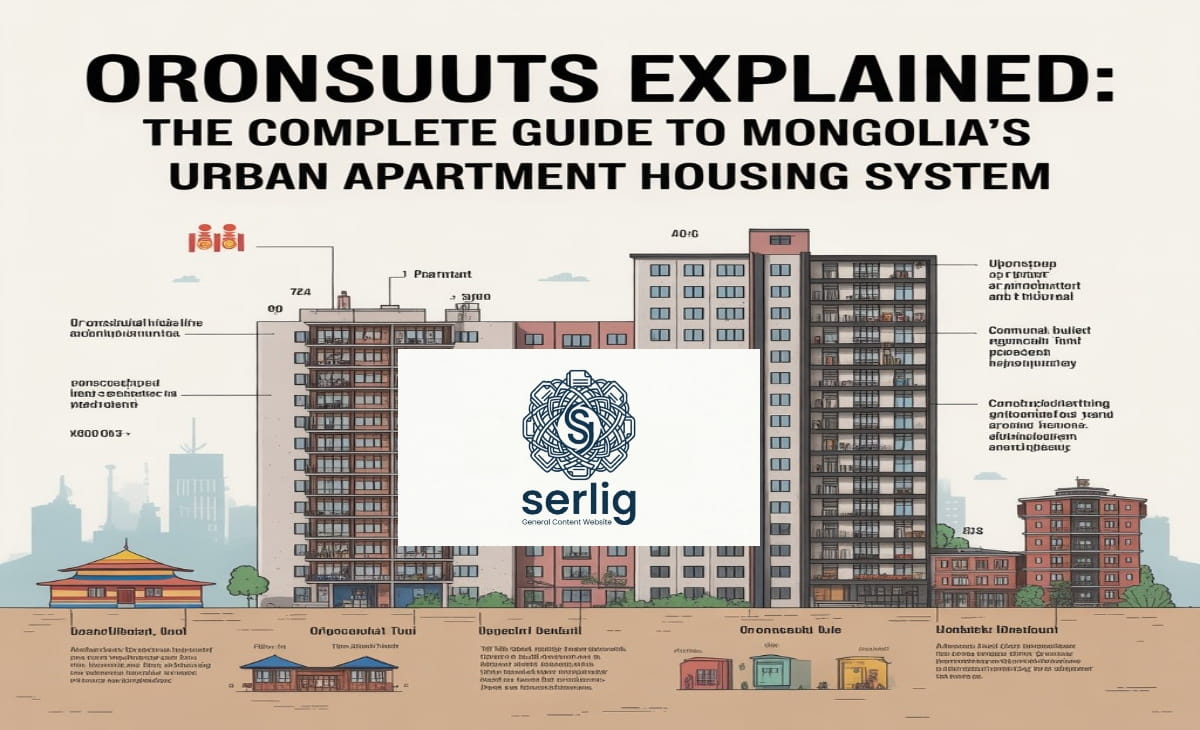
Ulaanbaatar’s skyline today mixes aging Soviet blocks with sleek modern towers. Both serve the same core purpose: keeping millions of Mongolians warm, housed, and connected to city life.
How the Oronsuuts System Works
Oronsuuts is not just a building — it is an integrated housing system. Multiple families share a structure and, crucially, share essential services that make city life viable in one of the world’s most extreme climates.
Central Heating: The Most Critical Feature
Mongolia suffers some of the world’s most severe winters. Ulaanbaatar is home to more than 1.4 million people, and its city core largely comprises apartment blocks served by comprehensive utility services including district heating, piped water supply, and wastewater collection and treatment.
January temperatures regularly drop to −40°C. In this context, reliable heating is not a comfort — it is a survival necessity. Oronsuuts buildings tap into municipal district heating networks, delivering warmth centrally to every apartment. Residents do not manage their own boilers or purchase coal. This single feature represents Oronsuuts’ most significant advantage over ger district living.
Running Water and Sanitation
Every Oronsuuts apartment delivers hot and cold running water, flush toilets, and full sewage connections. Ger districts, by contrast, rely on shared water kiosks and outdoor latrines — a significant hardship during winter months and a major driver of internal migration toward apartment living.
Shared Common Infrastructure
Stairwells, elevators, entrance halls, and courtyard spaces belong to all residents. They require regular upkeep to function properly. The quality of this shared infrastructure often determines a building’s overall livability.
Property Management
Buildings operate either through a homeowners’ association or a hired management company. These bodies collect maintenance fees, coordinate repairs, and keep shared systems running. Management quality varies enormously across Ulaanbaatar — well-managed buildings stay clean and functional, while poorly managed ones deteriorate visibly.
Who Lives in Oronsuuts?
Oronsuuts residents span the full breadth of Mongolian urban society:
Students rent small units near campuses. Universities in central Ulaanbaatar districts attract young renters who prioritize location and price over space.
Young professionals buy or rent in newer central districts, drawn by proximity to offices, cafes, and public transport.
Families take larger apartments, sometimes across multiple generations sharing a single unit or building.
Elderly residents often occupy flats they received or purchased during the Soviet era and have lived in for decades.
Expatriates — particularly those working in Mongolia’s mining, finance, and diplomatic sectors — rent or buy in premium central districts. The expat market has grown significantly as Mongolia’s economy has expanded.
Internal migrants represent a major and growing segment. Ger area migration has grown at approximately 25,000 people per year since 2012, accounting for more than half of Ulaanbaatar’s urban growth rate. For these families, moving into an Oronsuuts apartment represents both a practical improvement in living conditions and a significant social milestone.
Renting in Ulaanbaatar: 2026 Prices and What to Expect
Current Rental Market
Apartment prices in Ulaanbaatar have seen consistent increases, with both new and existing units rising over 12–14% year-on-year by late 2025, reflecting strong demand. With rising housing prices, rental demand remains robust — particularly among students and professionals who prefer flexible living without large upfront investments.
2026 Rental Price Benchmarks:
| Apartment Type | City Centre | Outside Centre |
| 1-bedroom | ~$421/month | ~$329/month |
| 3-bedroom | ~$1,230/month | ~$741/month |
Source: Verified cost-of-living data, May 2026
Best Neighbourhoods for Renters
The top picks in 2026 include Sükhbaatar District (City Centre) — the core of Ulaanbaatar, close to Sukhbaatar Square, the State Department Store, and embassies. Rent is high but worth it for professionals who need to walk to everything.
Other popular areas include:
Khan-Uul District — newer residential developments, good transport links, popular with families and expats.
Bayanzurkh District — more affordable than the centre, growing infrastructure, popular with young professionals and students.
Chingeltei District — central location, mix of Soviet-era and newer buildings, varied price points.
What to Check Before Signing a Rental Contract
- Whether district heating costs are bundled into rent or charged separately — this matters enormously in winter
- Internet connectivity — fiber is now standard in newer buildings, but older Soviet-era blocks can vary
- Elevator condition in mid-to-high-rise buildings
- Management company reputation — ask current residents if possible
- Proximity to public transport routes
Buying an Oronsuuts Apartment: What You Need to Know
The Buying Process
Purchasing an Oronsuuts apartment involves several steps that differ from Western real estate markets:
Document verification comes first. Buyers verify ownership through official Mongolian government portals. This step is non-negotiable — title disputes are a documented issue in Mongolia’s fast-growing property market.
Developer history matters for new builds. Some projects have faced quality issues, delayed delivery, or incomplete common infrastructure. Researching developer track records before committing is essential.
Pre-purchase inspections are standard practice. Heating system integrity, plumbing, electrical wiring, and structural condition all warrant professional assessment — particularly in older Soviet-era buildings.
Mortgages are available through Mongolian banks, and government subsidy programmes have expanded access to homeownership for lower-income buyers.
Foreign Buyers
Foreigners can rent Oronsuuts apartments in Mongolia without restriction. Property purchase rules for foreign nationals follow specific Mongolian legal requirements. Any foreign buyer should consult a locally licensed legal expert before proceeding — the rules are specific and penalties for non-compliance are significant.
Investment Perspective
Many locals buy Oronsuuts apartments as long-term investments. Prices per square meter in central districts like Sukhbaatar can exceed millions of Mongolian Tugriks. The combination of strong urbanization pressure, limited central supply, and consistent population growth has made central Ulaanbaatar apartments a historically reliable store of value.
The Challenges Facing Oronsuuts in 2026
Aging Soviet Infrastructure
A significant portion of Ulaanbaatar’s housing stock dates to the Soviet era. Heating pipes, electrical systems, elevators, and structural elements in these buildings are now decades old. Renovation investment varies enormously — some buildings receive active management and regular upgrades; others show visible deterioration with deferred maintenance piling up.
Population Pressure and Supply Constraints
Mongolia has experienced unprecedented urbanization over the past two decades, with both rapid multi-story housing development and expansion of traditional ger districts, which now house approximately 50% of the urban population.
Migration continues at pace. Ger areas have spread and expanded through successive waves of migration estimated at 25,000 per year since 2012. New apartment districts expand at the city’s edges, but central heating networks, schools, and public services often arrive later than the buildings themselves.
Air Pollution: A Crisis That Affects Everyone
Ulaanbaatar’s air quality crisis is among the most severe of any capital city in the world. The primary source is coal burning in ger districts during winter. Oronsuuts residents do not burn coal themselves — but they breathe the same air.
Ger areas are hotspots of greenhouse emissions and air pollution, mainly due to the widespread use of coal for heating and cooking. On the worst winter days, smog blankets the entire city regardless of where you live. This affects health, quality of life, and property values in affected zones.
Uneven Management Quality
Buildings with active, organized homeowners’ associations maintain standards. Buildings without strong management deteriorate — common areas decay, repairs accumulate, and disputes between neighbours escalate. This creates a wide quality gap within the Oronsuuts market that is not always visible from property listings.
The Future: Mongolia’s Major Housing Transformation
Several large-scale initiatives are reshaping Ulaanbaatar’s housing landscape through the late 2020s.
The ADB Green Affordable Housing Project
The Asian Development Bank’s Ulaanbaatar Green Affordable Housing and Resilient Urban Renewal Sector Project aims to deliver sustainable and comprehensive solutions to transform the substandard, climate-vulnerable, and heavily polluting ger areas of Ulaanbaatar into affordable, low-carbon, climate-resilient, and livable eco-districts. The project will leverage private sector investment to deliver 10,000 affordable green housing units and redevelop 100 hectares of ger areas into eco-districts.
The 500 or so homes to be built in each eco-district will comprise 15% for rent or rent-to-own homes, 55% low-cost homes, and 30% homes sold at market rate to ensure all families can continue to live in the neighbourhood. The eco-districts will be developed with district heating systems.
This $570 million project — financed by ADB and the Green Climate Fund — represents the most significant housing investment in Mongolia’s history.
Ulaanbaatar’s Mega Infrastructure Projects (2025–2028)
The Municipality of Ulaanbaatar has announced a series of mega projects running between 2025 and 2028 that will directly affect apartment living conditions across the city. These include a metro system, tramway network, ring road, and multiple major housing developments in ger district sub-centres — all aimed at reducing traffic congestion and air pollution while expanding livable apartment housing.
Sustainable Design Standards
New premium Oronsuuts developments increasingly incorporate energy-efficient building envelopes, smart home technology, triple-glazed windows, and sustainable materials. The government’s push to move ger district residents into connected housing aligns with international climate commitments and EU-funded energy efficiency programmes already running in the city.
Secondary Cities
Secondary cities such as Darkhan and Erdenet present a valuable opportunity to address housing disparities before they replicate the severe challenges seen in Ulaanbaatar. A World Bank blueprint published in 2025 outlines how green, resilient housing development in these cities can establish better standards from the outset — rather than retrofitting infrastructure after informal settlement has already spread.
Oronsuuts vs. Ger District Living: An Honest Comparison
Many visitors to Mongolia romanticize ger living. The reality for urban residents is more nuanced.
| Factor | Oronsuuts Apartment | Ger District |
| Winter heating | Central district heating | Individual coal stoves |
| Air quality | Better (no direct burning) | Very poor in winter |
| Running water | Full indoor plumbing | Shared water kiosks |
| Sanitation | Indoor flush toilets | Outdoor latrines |
| Cost | Higher (rent or mortgage) | Lower (land allocation) |
| Community | Building-level ties | Strong neighbourhood bonds |
| Location | Urban central access | Typically peri-urban |
| Cultural identity | Modern urban | Closer to nomadic roots |
The choice is rarely simple. Many families value the community bonds and cultural continuity of ger districts deeply. The move to Oronsuuts is a practical upgrade in living conditions, but it is also a cultural transition that carries genuine weight.
Frequently Asked Questions
What does Oronsuuts mean in English?
Oronsuuts comes from the Mongolian phrase орон сууц and translates directly to “residential housing” or “apartment.” Mongolians use it as the everyday word for an apartment building or flat, exactly the way English speakers use “flat” or “apartment.”
Where do Oronsuuts apartments exist?
Mainly in Mongolian cities, with Ulaanbaatar holding the largest concentration. The system also operates in Darkhan, Erdenet, and other urban centres. Ulaanbaatar’s apartment districts cover a mix of Soviet-era blocks and modern high-rise developments.
How much does it cost to rent an Oronsuuts apartment in 2026?
A one-bedroom apartment in central Ulaanbaatar costs approximately $421 per month on average. Outside the centre, expect around $329 per month. Three-bedroom apartments in the centre average around $1,230 per month. Prices have risen 12–14% year-on-year through 2025.
Why do people prefer Oronsuuts over ger district living?
Oronsuuts apartments offer central heating, indoor plumbing, clean water, and sewage connections — all essential during Mongolia’s brutal winters. Ger districts lack much of this infrastructure, making daily life significantly harder, especially for families with children or elderly members.
Can foreigners rent or buy Oronsuuts apartments?
Foreigners can rent Oronsuuts apartments without restriction. Property purchase rules for foreign nationals follow specific Mongolian legal requirements. Buyers should consult a locally licensed legal expert before proceeding.
Is Oronsuuts related to streaming or movies online?
No. Oronsuuts is entirely a Mongolian housing term. Some websites misuse the word to attract search traffic toward unrelated digital content. Always check your source — the true meaning of Oronsuuts connects solely to urban residential housing in Mongolia.
What is Mongolia doing about housing for ger district residents?
The ADB and Green Climate Fund have committed over $570 million to build 10,000 affordable green housing units and redevelop 100 hectares of ger areas into eco-districts with district heating and modern infrastructure. The Municipality of Ulaanbaatar is also running multiple housing redevelopment projects across the city’s major ger district sub-centres through 2028.
Continue reading with this related post: Senaven: Your Complete Guide to the Home Sanctuary Concept Transforming Modern Living
The Bottom Line
Oronsuuts is far more than a foreign-sounding word. It names the everyday apartment housing system that keeps over a million Mongolians warm, housed, and connected to city life through winters that reach −40°C.
Built on Soviet foundations, reshaped by market forces after 1990, and now undergoing its most significant transformation yet through green housing investment and urban renewal programmes, Oronsuuts sits at the heart of modern Mongolia’s social and economic story.
Whether you are exploring Mongolian culture, planning a move to Ulaanbaatar, researching real estate investment, or simply tracking down a word you spotted online — understanding Oronsuuts gives you a clear window into how one of the world’s most remarkable countries houses, heats, and sustains its people.