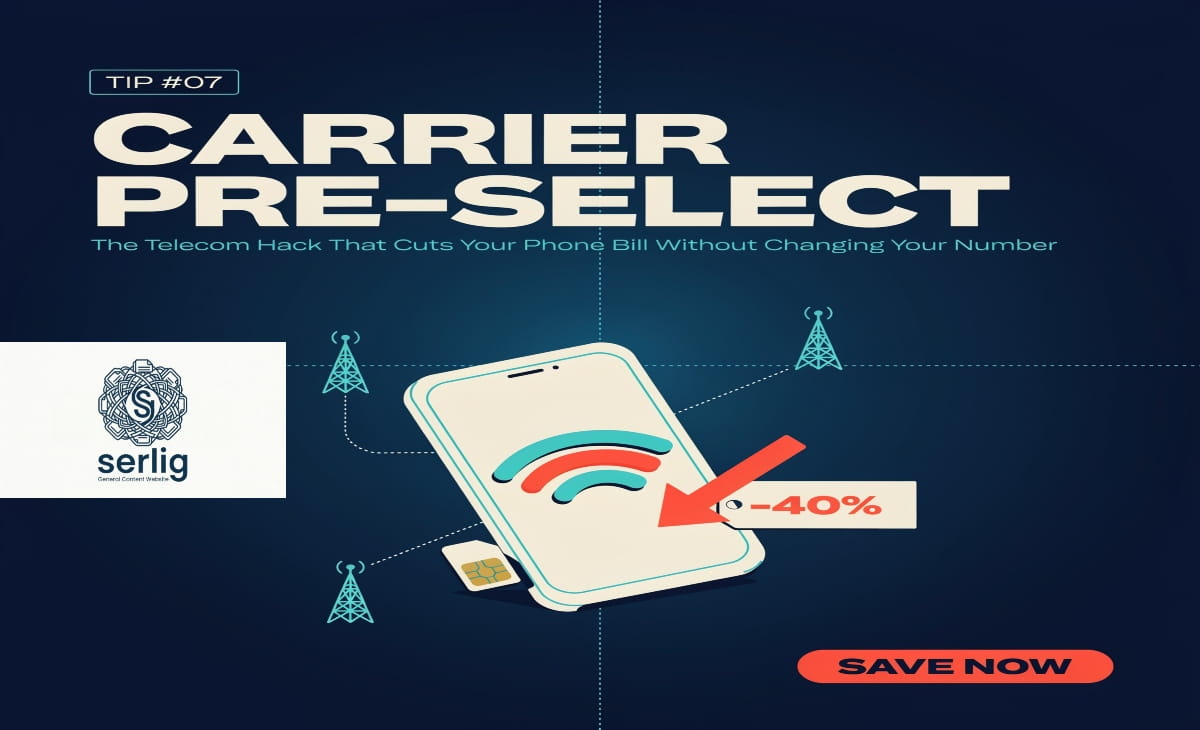
Carrier Pre Select: The Telecom Hack That Cuts Your Phone Bill Without Changing Your Number
Most people never think twice about who carries their phone call. They dial a number, and the call goes through. Simple. But what if that call was costing you more than it should? What if you could automatically route it through a cheaper provider — without touching your phone, changing your number, or installing any equipment?
That is exactly what carrier pre select (CPS) does.
CPS is a telecom service that lets you choose a preferred call carrier in advance. Once set up, every eligible outgoing call routes through that carrier automatically. You dial as normal. The savings happen behind the scenes.
This guide explains what carrier pre select is, how it works, who benefits from it, and why it still matters today.
Quick Fact Table
| Feature | Details |
| Full Name | Carrier Pre-Selection (CPS) |
| Type | Fixed-line telecommunications service |
| Purpose | Route calls through a cheaper alternative carrier |
| Equipment Needed | None |
| Number Change Required | No |
| Works on Mobile | No (landline only) |
| Key Benefit | Lower call costs, especially international |
| Related Service | Wholesale Line Rental (WLR) |
| Signaling Technology | SS7 (Signaling System 7) |
| Introduced | Late 1990s during telecom liberalization |
What Is Carrier Pre Select?
Carrier pre select is a telecommunications service. It allows customers to designate a preferred phone carrier for outgoing calls. No special codes. No new equipment, also no number changes.
Once activated, the local telephone exchange routes your calls through the chosen carrier automatically. You keep your existing line. You keep your existing number. The only thing that changes is where your call traffic travels after leaving the exchange.
CPS works by separating two things that were once bundled together:
- The physical line — the copper wire into your home or office, owned by the incumbent provider
- The call traffic — the actual voice data travelling across networks, managed by your chosen CPS carrier
This separation is the key idea. It gives customers the freedom to choose who carries their calls — even if they cannot change who owns their phone line.
CPS was originally built for landlines. It remains most relevant in fixed-line markets. But the principles it introduced — open networks, competitive routing, and consumer choice — shaped telecoms policy worldwide.
A Brief History: Why Carrier Pre Select Was Created
For most of the twentieth century, telephone services were monopolies.
One national operator controlled everything. The physical lines. The switching equipment. The billing. Consumers had no alternative. If you wanted a phone, you used whoever owned the wires.
In the 1980s and 1990s, governments began changing this. They opened telecom markets to competition. New providers entered. Prices started falling.
But there was a problem.
New carriers could build switching infrastructure. They could not realistically replicate the “last mile” — the copper wire running into every home and office. That wire belonged to the incumbent. Alternative providers were stuck.
Regulators needed a solution. Carrier pre select was it.
By requiring incumbent operators to allow competitors to carry calls over their infrastructure, regulators opened the door to real competition. New providers could serve existing customers. Consumers gained choice. The incumbent lost its stranglehold on call revenue.
In the UK, BT was required to support CPS. Competitors like TalkTalk could then offer rival calling services to BT line customers. The same model was replicated across Europe and beyond.
CPS did not just change phone bills. It changed the structure of the entire telecoms industry.
How Carrier Pre Select Works
The process is straightforward for the customer. The technical work happens inside the network.
- The customer signs up with a CPS provider.
- The CPS provider registers the customer’s line with the local telephone exchange.
- The exchange stores the CPS preference against that line.
- When the customer makes a call, the exchange reads the stored preference.
- The call automatically routes through the chosen carrier’s network.
The customer dials as normal. No prefix. No access code, also no extra steps.
The switching happens at the exchange level. It takes milliseconds. Networks use Signaling System 7 (SS7) to communicate the routing instructions. A unique identifier — the PIC code (Primary Interexchange Carrier code) — links the line to the chosen carrier in the exchange database.
What Types of Calls Does CPS Cover?
CPS can apply to different call categories:
| Call Type | Description |
| All outgoing calls | Every call routes through the CPS carrier |
| National long-distance | Only calls to distant regions |
| International calls | Only calls routed abroad |
| Mobile calls | Only calls to mobile numbers |
This flexibility is valuable. A business might choose one carrier for international calls and keep local calls on the default provider. Each category can be configured separately.
Key Benefits of Carrier Pre Select
1. Lower Call Costs
Alternative carriers often charge less than the incumbent — especially for international and long-distance calls. CPS routes your calls through the cheaper provider automatically. Savings accumulate with every call, without any extra effort.
2. Zero Equipment Changes
CPS needs no new hardware. No installation engineers. No rewiring. The change happens entirely within the network. Your handsets, your line, and your number all stay the same.
3. No Manual Dialing Codes
Older indirect access systems required a prefix code before every call. CPS removes that friction entirely. The routing is automatic and invisible.
4. Increased Market Competition
CPS opened telecom markets to genuine competition. Smaller carriers could compete for call traffic without owning last-mile infrastructure. This drove prices down and pushed service quality up across the industry.
5. Simpler Billing
All CPS calls appear on one bill from the chosen carrier. Businesses find it easier to track spending, set budgets, and spot savings opportunities.
6. Consistent Routing
A correctly configured CPS setup always routes calls through the selected provider. There is no risk of calls defaulting back to the expensive incumbent network unexpectedly.
Carrier Pre Select vs. Wholesale Line Rental (WLR)
These two services are closely related. But they work at different levels.
| Feature | CPS | WLR |
| Controls call routing | Yes | Yes |
| Controls physical line | No | Yes |
| Separate line rental bill | Yes | No (bundled) |
| Single provider experience | No | Yes |
| Equipment change needed | No | No |
CPS handles only the outgoing call traffic. The physical line stays with the incumbent. Customers receive two bills: one for line rental, one for calls.
WLR transfers management of the physical line to the alternative provider. That provider handles fault reporting, billing, and line management. The customer gets one bill and one point of contact.
Many telecom providers combine both. They use WLR plus CPS together. This creates a fully bundled service — one provider, one bill — while still running over the incumbent’s physical infrastructure.
Who Benefits Most from Carrier Pre Select?
High-Volume Call Centres
Call centres make thousands of outbound calls daily. Even a small reduction in per-minute rates saves significant money at scale. CPS delivers those savings without disrupting operations.
Multinational Businesses
Companies with frequent international calling benefit greatly. They configure CPS to route international calls through a specialist carrier with competitive rates. Local calls stay on the default provider.
Small and Medium-Sized Enterprises (SMEs)
SMEs gain predictable costs and simpler billing. Instead of variable charges from the incumbent, they lock in competitive rates with a CPS provider. Cash flow becomes more manageable.
Organizations on Legacy PSTN Infrastructure
Some businesses still run traditional PSTN phone systems. CPS works within that existing setup. No migration to VoIP required. Cost savings are available immediately.
Limitations of Carrier Pre Select
CPS is useful, but it has real constraints.
Fixed-Line Only CPS does not work on mobile networks. Mobile users looking to cut costs need SIM-only plans, MVNOs, or calling apps — not carrier pre selection.
Infrastructure Dependency CPS availability depends on the local incumbent’s infrastructure. In the UK, it is tied to BT fixed lines. Customers on other infrastructure may not have CPS access.
One Carrier per Call Type CPS assigns one preferred carrier per call category. Real-time switching between multiple carriers is not standard. Some advanced configurations can address this, but they add complexity.
Declining Relevance in VoIP Environments As businesses migrate to VoIP, cloud PBX, and unified communications platforms, CPS becomes less relevant. VoIP systems have built-in routing logic. They often deliver more flexibility and control than CPS alone.
Carrier Pre Select in the Modern Telecom Landscape
VoIP, 5G, and cloud communications now dominate the industry. Traditional fixed-line telephony is shrinking. Does CPS still matter?
Yes — for several reasons.
Legacy infrastructure still exists. Many businesses and households worldwide rely on PSTN lines. Broadband rollout is uneven. In regions where VoIP is not yet viable, CPS remains a live cost-saving option.
Regulatory frameworks remain active. CPS rules are still embedded in telecoms regulations across many countries. They protect consumer rights and maintain competitive markets.
Hybrid environments are common. Many organizations run a mix of legacy PSTN and modern VoIP systems. CPS continues to optimize costs on the PSTN side of those hybrid setups.
CPS principles endure. Even where CPS itself is fading, the ideas it introduced — service unbundling, infrastructure sharing, consumer choice — remain central to modern telecoms regulation and market design.
How to Set Up Carrier Pre Select
Setting up CPS is simple. The technical work is done by the provider.
- Research available CPS providers in your area. Compare per-minute rates for the call types you make most often — national, international, or mobile.
- Sign up with your chosen provider. Give them your phone number and line details.
- The provider registers your preference with the local exchange — usually the incumbent operator.
- Configuration completes within a short window. Your calls then route automatically through the new carrier.
- Check your first few bills to confirm the routing is working and savings are appearing as expected.
No engineer visits. No downtime, also no disruption.
Conclusion
Carrier pre select quietly transformed the telecoms industry. It broke open markets that were once locked tight by monopolies. It gave businesses and households a practical way to choose their call carrier — without changing their number, their line, or their equipment.
CPS introduced something important: the idea that owning the wire does not mean owning the call.
VoIP and mobile have taken over much of the space CPS once occupied. But for fixed-line users — especially businesses managing high call volumes or international traffic — CPS remains a relevant, accessible, and cost-effective tool.
Understanding CPS means understanding how modern telecom competition was built. And in the right environment, it still means lower bills starting from day one.
If this topic interests you, here’s another helpful article: tand d auto Shops: Honest Mechanics, Dealer-Level Skills Without the Dealer Bill
Frequently Asked Questions
What does carrier pre select mean?
Carrier pre select (CPS) is a telecom service that automatically routes your outgoing calls through a chosen carrier. You set it once. After that, calls route through the selected provider without any manual input from you.
Do I need new equipment for carrier pre select?
No. CPS requires no new hardware, no installation, and no wiring changes. The configuration happens inside the telephone exchange. Your handsets and existing setup stay exactly as they are.
Can I use carrier pre select on my mobile phone?
No. CPS is a fixed-line service only. It works at the telephone exchange level on landlines. Mobile networks use a different architecture. Mobile users need SIM-only deals or calling apps to reduce costs.
Will carrier pre select change my phone number?
No. Your phone number stays the same. CPS only changes the network path your outgoing calls take. Your line, your number, and your handset are unaffected.
Is carrier pre-select still relevant in 2025?
Yes, in specific contexts. CPS remains relevant for businesses using legacy PSTN infrastructure, organizations in regions without full VoIP coverage, and hybrid environments where both fixed-line and VoIP systems operate together. For pure VoIP setups, CPS is largely superseded by built-in call routing features.