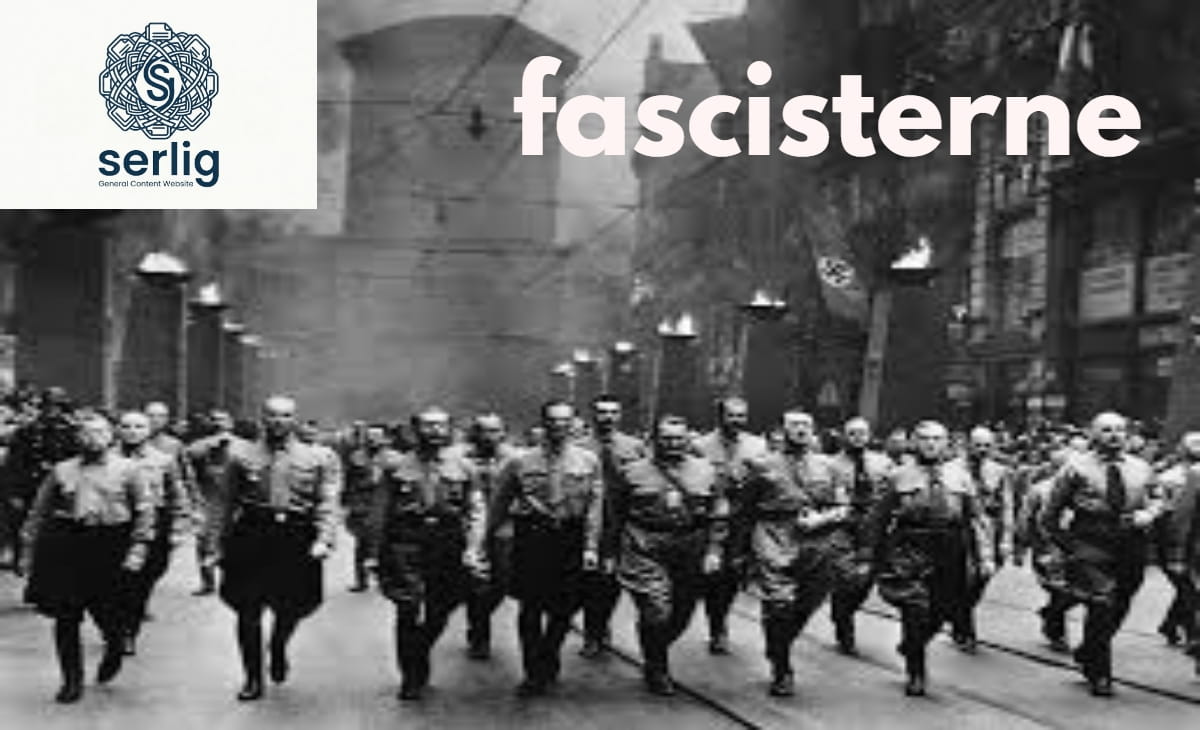
Fascisterne Exposed: The Dark Truth Behind History’s Most Dangerous Ideology (And Why It’s Back)
Fascisterne is a Danish word that translates directly to “the fascists.” Reducing it to a simple translation, however, ignores the enormous weight of history it carries. The word captures one of the most destructive political ideologies ever to take root in human civilization — a worldview built on authoritarian power, aggressive nationalism, racial hierarchy, propaganda, and the deliberate dismantling of democratic values.
From the shattered trenches of post-World War I Europe to the ruins of the Second World War, fascisterne reshaped the modern world through violence, fear, and the corruption of national identity. Understanding fascisterne is not merely a historical exercise. It is a living, urgent lesson for our present moment.
Populist nationalism now resurfaces across the globe. Democratic institutions face unprecedented strain. Extremist movements find new life on digital platforms. For all these reasons, the history of fascisterne grows more relevant — not less — with every passing year. This article explores the origins, ideology, key figures, societal impact, and enduring legacy of fascisterne, and explains why these lessons matter more than ever today.
Quick Fact Table: Fascisterne at a Glance
| Feature | Detail |
| Word Origin | Danish — means “the fascists” |
| Root Language | Italian fascio / Latin fasces |
| Ideology Born | Post-World War I Europe (~1919) |
| Key Figures | Mussolini (Italy), Hitler (Germany), Franco (Spain) |
| Peak Period | 1922–1945 |
| WWII Deaths (est.) | 70–85 million globally |
| Holocaust Victims | 6 million Jews + millions of others |
| Denmark Occupied | April 1940 – May 1945 |
| Nuremberg Trials | 1945–1946 |
| Modern Threat | Digital radicalization, far-right populism |
What Does Fascisterne Mean?
In Danish, “fascisterne” means “the fascists” — the definite plural form of “fascist.” The root word traces back to the Italian fascio, meaning a bundle or group, itself derived from the Latin fasces — the ancient Roman symbol of bundled rods representing collective strength and authority. The symbolism runs deep: fascism always sought to subordinate the individual to the collective will of the state and its supreme leader.
The Danish Connection
During World War II, the term gained specific weight in Danish cultural and political memory. Nazi Germany occupied Denmark from April 1940 to May 1945. The fascisterne — both foreign occupiers and Danish collaborators — posed a direct threat to Danish society, Jewish communities, and democratic life. The word carried connotations of betrayal, ideological extremism, and moral collapse.
Today, historians, educators, and political analysts use the term to reference the full spectrum of 20th-century fascist movements. It serves as a powerful shorthand for one of history’s most catastrophic political phenomena — a reminder encoded in language itself.
Historical Origins: The Fertile Ground of Post-War Crisis
The history of fascisterne begins in the ruins of World War I. Between 1914 and 1918, approximately 20 million people died. Four major empires — Ottoman, Austro-Hungarian, Russian, and German — collapsed. Survivors returned to economies in ruin, cities scarred by poverty, and governments that appeared helpless before the scale of social collapse.
Italy: The First Fascist State
In Italy, veterans and nationalists felt betrayed by the Paris Peace Conference of 1919. The conference denied Italy the territorial gains it had been promised in exchange for entering the war on the Allied side. That wounded national pride became the emotional fuel Benito Mussolini ignited.
In 1919, Mussolini founded the Fasci Italiani di Combattimento — the Italian Combat Leagues — drawing together veterans, nationalists, and discontented workers. By 1922, his movement had grown powerful enough to march on Rome. The Italian king appointed him prime minister, and within a few years Mussolini dismantled parliamentary democracy entirely, establishing a one-party fascist dictatorship.
Germany: The Nazi Escalation
Germany followed a parallel but even more catastrophic path. The Treaty of Versailles in 1919 imposed harsh reparations, stripped Germany of territory, and humiliated its population. The Weimar Republic — Germany’s first democratic experiment — struggled against hyperinflation, mass unemployment, and violent political conflict from both left and right.
Adolf Hitler and the National Socialist German Workers’ Party (NSDAP) exploited this crisis masterfully. Hitler became chancellor in January 1933. Within months, his government transformed Germany into a totalitarian state, abolishing competing political parties and placing every institution of public life under party control.
The European Spread
Fascist movements spread across Spain under Francisco Franco, Hungary, Romania, Austria, and even into Scandinavia. Fringe parties and collaborationist networks across Europe aligned themselves with Nazi occupation — earning the label fascisterne from those who resisted them.
Core Ideology: The Seven Pillars of Fascisterne
A shared set of ideological commitments unified the various fascist movements of the 20th century and distinguished them from other authoritarian systems.
- Ultranationalism Fascisterne placed the nation above everything — not as a civic concept of shared rights and laws, but as an organic, racial, or cultural entity demanding absolute loyalty. They portrayed the nation as a living organism under constant threat from internal enemies and foreign powers.
- Totalitarian State Authority Fascism rejected any distinction between public and private life. The state claimed the right to regulate culture, family life, education, the press, the arts, religion, and the economy. Every institution bent to party control, and dissent became treason.
- The Cult of the Leader Every major fascist movement centered on a charismatic, infallible leader: Mussolini as Il Duce, Hitler as Der Führer, Franco as El Caudillo. These figures were not ordinary politicians. Followers treated them as quasi-mythological embodiments of national destiny, and the leader’s personal will replaced the rule of law.
- Rejection of Liberal Democracy Fascisterne held parliamentary democracy in contempt. They viewed elected governments as weak, corrupt, and easily manipulated by special interests. Fascism promised decisiveness, order, and strength — qualities democracy, with its negotiations and compromises, supposedly could never deliver.
- Racism and Racial Hierarchy In its Nazi form especially, fascism was inseparable from racial ideology. Nazi doctrine deemed the Aryan race superior. Jews, Roma, disabled people, and other groups faced systematic dehumanization, persecution, and ultimately genocide. Even non-racial fascism relied on constructing an internal “enemy” — a scapegoat onto whom social anxieties could be endlessly projected.
- Militarism and the Glorification of Violence Fascisterne glorified military strength, war sacrifice, and political violence. Paramilitary forces — Italy’s Blackshirts, Germany’s SA and SS — attacked opponents, intimidated citizens, and enforced ideological conformity both before and after these movements seized power.
- Anti-Communism and Anti-Liberalism Fascism positioned itself as the great bulwark against communism, winning support from business elites and conservative establishments who feared Bolshevik revolution. Simultaneously, it rejected liberal values — individual rights, free markets, pluralism — offering instead a “third way” of state-directed corporatism and enforced national unity.
The Rise to Power: How Fascisterne Conquered Democracies
One of history’s most disturbing revelations is that fascism did not always conquer democracy through simple military coups. In many cases, fascisterne rose through democratic processes — exploiting elections, legal loopholes, and the failures of opponents.
Democracy Used Against Itself
Mussolini received his appointment as prime minister through constitutional means. Conservatives appointed Hitler as chancellor, believing they could control him. Both men then used existing laws to dismantle existing laws. They won popular support by offering solutions — however catastrophic — to real problems: unemployment, national humiliation, social disorder.
Propaganda as the Master Weapon
Propaganda played a central role in this process. Joseph Goebbels, Hitler’s minister of propaganda, understood that emotions, symbols, and repetition outperformed rational argument. Nuremberg rallies, radio broadcasts, and state-controlled film manufactured mass consent and cultivated deep personal devotion. Citizens were not merely ruled — they actively participated in their own domination.
Dismantling Democratic Safeguards
Once in power, fascisterne moved fast to eliminate every mechanism that could dislodge them. Political parties faced bans. Authorities dissolved trade unions. Leaders packed or replaced courts. State control consumed the press. Opponents went to prison, into exile, or to their deaths. Within years of taking power, both Mussolini and Hitler had built systems where removing them through normal political means had become essentially impossible.
Fascisterne During World War II: The Catastrophic Consequences
World War II revealed the full horror that fascisterne could produce. Germany invaded Poland on September 1, 1939, triggering a conflict that killed an estimated 70 to 85 million people — the deadliest war in human history.
The Holocaust
The Holocaust stands as fascism’s most monstrous product. The Nazi regime murdered six million Jews alongside millions of Roma, disabled people, political prisoners, Soviet POWs, and others. This was not incidental to fascism — it was the logical endpoint of its racial ideology, pursued with bureaucratic precision and industrial efficiency.
Collaboration Across Europe
Fascist collaboration took many forms across occupied Europe. Some governments formally allied with Nazi Germany. Others — like Vichy France — collaborated under occupation. Denmark presents a complex case: while most Danes eventually resisted or maintained difficult neutrality, a collaborationist minority actively aided the occupiers. These individuals earned the label fascisterne — traitors who chose ideology over their own people.
Defeat and Accountability
Italy’s war ended in 1943 when Allied forces invaded Sicily and the Italian Grand Council removed Mussolini from power. Germany fought on until May 1945, when Hitler died by suicide in his Berlin bunker and the Nazi regime surrendered unconditionally.
The Nuremberg Trials of 1945–1946 then attempted something unprecedented: holding political and military leaders personally accountable for crimes against humanity. For the first time, launching aggressive war and orchestrating genocide became individual criminal acts under international law. Those trials established precedents that eventually led to the creation of the International Criminal Court.
Postwar Reckoning: Suppression, Memory, and Incomplete Justice
Denazification and Legal Bans
In the decades after World War II, Europe undertook a painful process of denazification and defascistization. Germany banned the Nazi Party, its symbols, and Holocaust denial. Italy dismantled the official structures of fascism, though the process moved more slowly and remained less complete. International bodies and national laws across the continent worked to keep fascist movements from returning to power.
Preserving the Memory
Europe also deliberately confronted the memory of fascisterne through museums, memorials, literature, and education. Sites like Auschwitz-Birkenau in Poland and the Anne Frank House in Amsterdam stand as physical reminders of what fascism produced at its most extreme. Holocaust education became mandatory across much of Europe and in many other countries worldwide.
The Persistence of Neo-Fascism
Yet suppression was never total. Fascist and neo-Nazi movements continued operating throughout the postwar decades, often underground or under euphemistic names. Neo-fascist terrorism struck Italy and Germany during the 1970s and 1980s. After the Cold War, far-right nationalism resurged across Eastern Europe, where some fascist-era collaborators were rehabilitated or even celebrated by nationalist movements. The lesson was clear: declaring fascism defeated once did not make it gone forever.
Modern-Day Echoes: Fascisterne in the 21st Century
The 21st century has brought renewed alarm about fascist-adjacent politics. Scholars debate precise definitions of “neofascism,” “far-right populism,” and “illiberal democracy,” but certain patterns have emerged clearly across multiple countries.
Contemporary Movements
Across Europe, North America, and beyond, movements share key characteristics with historical fascisterne: aggressive nationalism, demonization of minorities and immigrants, attacks on the free press and judiciary, glorification of a charismatic strongman, and the framing of political opponents as existential enemies rather than democratic rivals.
Hungary under Viktor Orbán systematically weakened judicial independence, restricted press freedom, and promoted an ethnically exclusionary national identity. Poland saw similar trends under the Law and Justice party. France’s National Rally reached presidential election runoffs in both 2002 and 2022. Across the Atlantic, scholars like Robert Paxton and Timothy Snyder applied fascism studies directly to analyzing contemporary American political developments.
Digital Radicalization
The digital age has dramatically accelerated the spread of fascist and neo-fascist ideas. Social media platforms allow extremist content to reach millions of people, bypassing traditional gatekeepers. Online communities have radicalized individuals into mass violence — from the Christchurch mosque shootings of 2019 to the U.S. Capitol insurrection of January 6, 2021. Understanding the propaganda techniques and ideological appeals of historical fascisterne is directly relevant to combating these modern threats.
Key Warning Signs: How to Recognize Fascist Patterns Today
Historian Umberto Eco, who grew up under Italian fascism, identified recurring features of fascist thought he called “Ur-Fascism” or “Eternal Fascism.” His list includes: worship of tradition and rejection of modernism; the appeal to emotion over reason; action valued for its own sake; disagreement treated as betrayal; fear of difference; appeals to a frustrated middle class; nationalism fused with xenophobia; and portrayal of enemies as simultaneously all-powerful and contemptible.
Political scientist Jason Stanley, in How Fascism Works, identifies similar patterns: a mythologized national past, propaganda that destroys shared reality, anti-intellectualism, attacks on equality, and the glorification of violence. Recognizing these patterns in current political discourse is not alarmism. It is historically informed vigilance — the exact kind of awareness that democratic societies need to protect themselves.
Lessons of Fascisterne: Why History Must Be Actively Remembered
The history of fascisterne delivers some of the most sobering lessons in modern political thought. Democratic societies are not immune to authoritarian appeal, especially during economic stress, social disruption, and cultural anxiety. Fascism did not rise because Europeans were uniquely evil. It rose because ordinary people made incremental choices that allowed extraordinary evil to take hold.
The lesson cannot rest as a passive “never again” slogan. Active obligations follow from it: protect institutions, defend the free press, uphold judicial independence, refuse the scapegoating of minorities, and hold leaders accountable to law. Robust civic education must help citizens recognize propaganda when they encounter it. International structures — the United Nations, the International Criminal Court, human rights treaties — that emerged directly from the wreckage of fascisterne need constant defense and renewal.
Conclusion: The Word That Still Warns
Fascisterne — the fascists — left a mark on the 20th century that no amount of time will erase. They brought war, genocide, occupation, and the near-total destruction of democratic civilization across an entire continent. They showed what happens when nationalism turns pathological, when leaders rise above the law, and when entire populations are dehumanized in the service of political power.
Yet in their defeat, fascisterne also produced something powerful: a global commitment to human dignity, international law, and democratic governance. Every generation must renew that commitment by actively studying what happened, honestly examining why it happened, and staying vigilant against the conditions that allow it to happen again. The word “fascisterne” may have Danish roots — but the warning it carries belongs to all of humanity.
Continue reading with this related post: Erestein: The Complete Story of a Medieval Dutch Castle
Frequently Asked Questions
What does fascisterne mean?
“Fascisterne” is a Danish word that means “the fascists.” It refers to followers and leaders of fascism — the authoritarian, ultranationalist political ideology that dominated parts of Europe during the 1920s through 1945. The word carries deep historical weight, especially in the context of Nazi Germany’s occupation of Denmark during World War II.
Where did fascisterne originally come from?
Fascisterne traces its roots to post-World War I Europe, primarily Italy and Germany. Benito Mussolini founded the first organized fascist movement in Italy in 1919, while Adolf Hitler and the Nazi Party built their own version in Germany during the 1920s and early 1930s. The movement then spread to Spain, Hungary, Romania, and other European nations.
What were the core beliefs of fascisterne?
Fascisterne believed in ultranationalism, totalitarian state authority, a cult of infallible leadership, rejection of liberal democracy, racial hierarchy, the glorification of military violence, and opposition to both communism and liberalism. They placed the nation — defined in ethnic or racial terms — above the rights of any individual citizen.
How did fascisterne come to power in democratic countries?
Many fascist movements exploited democratic processes to gain power legally, then used existing laws to destroy democracy from within. They won support by exploiting economic crises, national humiliations, and fears of communism. Once in power, they banned opposition parties, controlled the press, packed courts, and used paramilitary violence to eliminate any possibility of removal by democratic means.
Is fascisterne still relevant today?
Absolutely. Scholars and political analysts identify clear echoes of fascisterne in several contemporary political movements — including aggressive nationalist parties in Europe, far-right populist governments that attack judicial independence and press freedom, and online extremist communities that use digital platforms to spread radicalization. Studying fascisterne helps modern citizens recognize early warning signs and protect democratic institutions before they erode.