20 Rosa Parks Quotes That Prove One Quiet Voice Can Change the World
Rosa Parks Quotes spoke simply. She acted quietly. Still, her words and deeds shook a nation to its core.
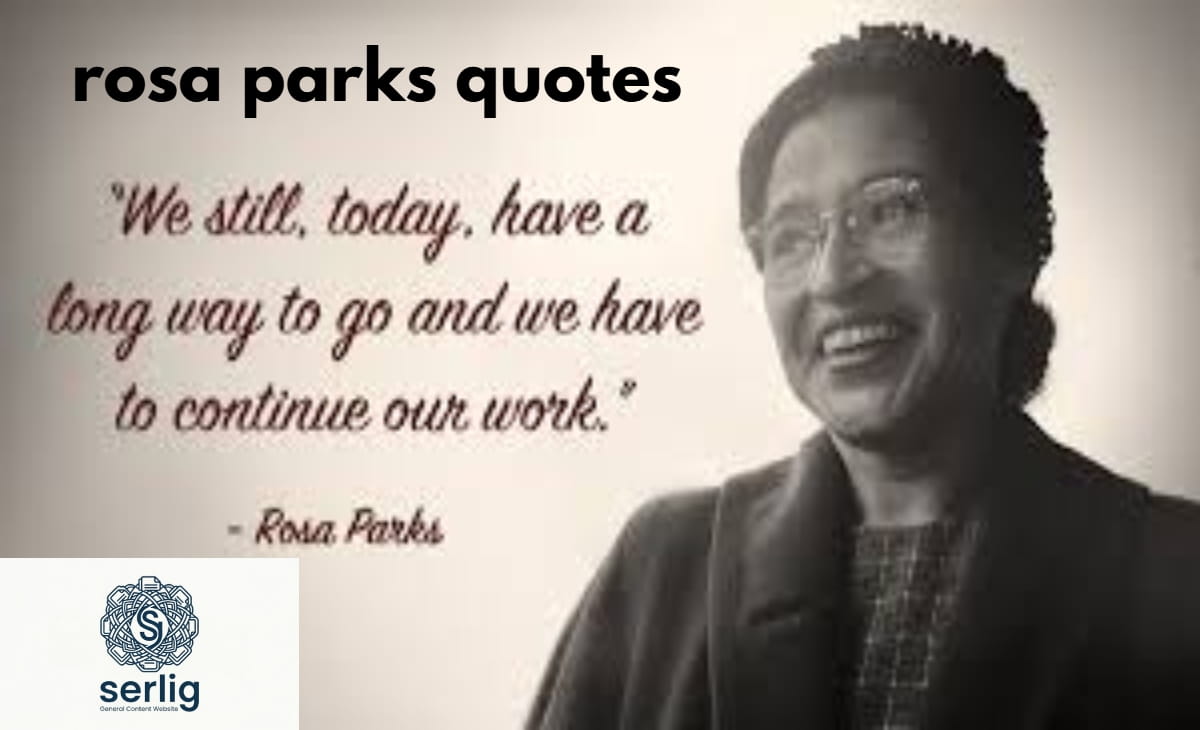
Known as the “Mother of the Civil Rights Movement,” Rosa Louise McCauley Parks (February 4, 1913 – October 24, 2005) was an African American civil rights activist whose single act of defiance on a Montgomery, Alabama bus on December 1, 1955, ignited one of the most consequential social movements in American history. Parks was far more than a symbol. A thinker, a writer, a speaker, and a lifelong advocate for justice — her quotes offer a window into the mind and heart of a woman who understood that freedom is not given. It must be demanded, one courageous step at a time.
This article explores her most powerful quotes, the stories behind them, and why her words remain as urgent and relevant today as they were decades ago.
Quick Facts Table: Rosa Parks at a Glance
| Detail | Information |
| Full Name | Rosa Louise McCauley Parks |
| Born | February 4, 1913, Tuskegee, Alabama |
| Died | October 24, 2005, Detroit, Michigan (age 92) |
| Known For | Refusing to give up her bus seat, December 1, 1955 |
| Movement | Montgomery Bus Boycott (381 days) |
| Awards | Presidential Medal of Freedom (1996), Congressional Gold Medal (1997) |
| Books Written | Rosa Parks: My Story (1992), Quiet Strength (1995) |
| Title | “Mother of the Civil Rights Movement” |
| Capitol Honor | First woman to lie in honor in the U.S. Capitol Rotunda |
The Most Famous Rosa Parks Quote: On Why She Refused to Move
Perhaps no Rosa Parks Quotes is more widely known than her explanation for staying seated on that Montgomery bus. When people assumed physical exhaustion drove her decision after a long day of work as a seamstress, she corrected them plainly:
“People always say that I didn’t give up my seat because I was tired, but that isn’t true. I was not tired physically… No, the only tired I was, was tired of giving in.”
This distinction mattered enormously to Parks. A deliberate, principled activist — not a weary woman who accidentally stumbled into history — she had served as secretary of the Montgomery NAACP chapter since 1943. Her refusal grew from years of witnessing and enduring racial injustice, not from a single tired moment.
When bus driver James Blake demanded she vacate her seat for a white passenger, Parks recalled answering with equal simplicity: “No, I will not.” Four words. A world changed.
Quotes on Courage and Doing What Is Right
Rosa Parks Quotes spoke often about the nature of courage — not as the absence of fear, but as the decision to act in spite of it. Drawing from her autobiography Rosa Parks: My Story (1992), this quote captures the moral clarity she carried throughout her life:
“You must never be fearful about what you are doing when it is right.”
Righteousness, not heroism in grand terms, guided her forward. Knowing deep in your bones that something is right — and letting that knowledge carry you even when fear is present — defined her entire approach.
On the difficulty of persistence, she reflected:
“There were times when it would have been easy to fall apart or to go in the opposite direction, but somehow I felt that if I took one more step, someone would come along to join me.”
Parks never saw herself as a lone revolutionary. Individual courage, in her view, creates space for others to follow. The Montgomery Bus Boycott — 381 days during which roughly 40,000 African American commuters refused to ride the city’s buses — proved exactly that.
Quotes on Freedom, Equality, and Justice
A broad and deeply held vision of justice defined Rosa Parks — one extending far beyond bus seats and American borders. Civil rights, in her eyes, formed part of a larger human struggle:
“I would like to be known as a person who is concerned about freedom and equality and justice and prosperity for all people.”
In a more personal formulation, she added:
“I would like to be remembered as a person who wanted to be free… so other people would also be free.”
Fighting for the conditions of life for millions of Black Americans under Jim Crow drove her forward — not personal recognition or individual gain. On universal human rights, her position was uncompromising:
“Differences of race, nationality or religion should not be used to deny any human being citizenship rights or privileges.”
At a time when racial segregation stood as law across much of America, articulating universal citizenship was a radical act. The American legal system had denied this vision to Black people for centuries — and Parks refused to accept that denial.
Quotes on Change and Taking Action
Throughout her life, Rosa Parks Quotes returned again and again to the necessity of action — not just belief, not just complaint, but concrete, embodied movement. Passive dissatisfaction earned little patience from her:
“To bring about change, you must not be afraid to take the first step. We will fail when we fail to try.”
Anyone who has hesitated in the face of injustice will recognize the weight of this statement. Parks understood from lived experience that one person’s action can set thousands in motion — but also that the first step is always the hardest.
Expanding on this theme, she declared:
“Without vision, people perish, and without courage and inspiration, dreams die.”
Vision, courage, and inspiration form a chain — each dependent on the others. Courage without vision has no direction. Vision without courage stays a wish. Inspiration without action remains hollow.
Quotes on Living as a Model for Others
Parks held deep awareness of the responsibility that comes with visibility. Daily choices either reinforce or undermine the values a person claims to hold:
“Each person must live their life as a model for others.”
Moral responsibility lands squarely on every individual with this quote — perhaps her most demanding. Holding the right beliefs never becomes enough. Embodying them is what counts.
On behavior and respect, she added:
“If you want to be respected for your actions, then your behavior must be above reproach. If our lives demonstrate that we are peaceful, humble, and trusted, this is recognized by others.”
Disciplined dignity — maintaining moral integrity under conditions that would justify rage or despair — marked her personal philosophy. This was not passive submission. It was principled, deliberate strength.
Quotes on Suffering, Resilience, and Moving Forward
Rosa Parks never stumbled into activism from a comfortable life. Growing up in the Deep South during Jim Crow, she witnessed racial terror and navigated a system built to dehumanize her. Hard-won wisdom — not abstract philosophy — shapes her words on resilience:
“What really matters is not whether we have problems, but whether we go through them. We must keep going on to make it through whatever we are facing.”
Acknowledging hardship — then insisting on continuing anyway — marked her approach throughout every difficult chapter. After her 1955 arrest, serious economic consequences followed immediately. Parks lost her seamstress job, received death threats, and eventually relocated with her husband Raymond to Detroit, Michigan, where she worked for years as an administrative aide to U.S. Representative John Conyers. Forward motion, for her, was always the only option.
Quotes on the Early Experience of Racial Injustice
Parks was not born an activist. Slowly absorbing the brutal reality of life in the segregated South shaped her, and she discussed this formative experience with striking honesty:
“I’d see the bus pass every day. But to me, that was a way of life; we had no choice but to accept what was the custom. The bus was among the first ways I realized there was a Black world and a white world.”
The injustice Parks eventually refused to accept had once seemed to her like simply the way things were. Far more than a vehicle, the bus delivered a daily lesson in who mattered and who did not. Moving from passive acceptance to active resistance reflects the power of consciousness-raising and organized civil rights work.
Her Legacy in Her Own Words
Rosa Parks received the Presidential Medal of Freedom in 1996 and the Congressional Gold Medal in 1997. Dying on October 24, 2005, at age 92, she became the first woman to lie in honor in the U.S. Capitol Rotunda. Time magazine placed her among the 20 most influential and iconic figures of the 20th century.
The most fitting summary of her legacy, however, comes directly from her:
“I want to be remembered as a person who wanted to be free and wanted other people to be free.”
Simple. Unadorned. Sufficient.
Maya Angelou once reflected: “I think Mrs. Parks unexpectedly had greatness thrust upon her. But had she not on that particular day said, ‘I’m not moving,’… we would have a different nation and a different world.”
Parks consistently redirected attention toward the movement rather than herself — yet her words reveal a sophisticated moral intelligence: someone who thought deeply about courage, dignity, collective action, and the meaning of freedom.
Why Rosa Parks Quotes Still Matter Today
Decades after the Montgomery Bus Boycott, Rosa Parks’ words continue to resonate — not because the problems she faced have been fully resolved, but because the struggle for equality, dignity, and justice continues. Museum pieces her quotes are not. Working tools they remain.
“You must never be fearful about what you are doing when it is right” speaks directly to every generation facing the temptation to stay silent in the face of injustice. “To bring about change, you must not be afraid to take the first step” addresses every individual who has wondered whether their action could possibly make a difference.
Rosa Parks proved that it can. Naming what is wrong — clearly and without apology — is itself a form of resistance. Her autobiography, speeches, and countless interviews stand as a testament to a mind that never stopped thinking about freedom and a voice that never stopped insisting on it.
Conclusion
Rosa Parks never gave a famous speech. She never led an army. Sitting still on a bus and saying no — then spending the rest of her long life speaking about courage, justice, equality, and resilience — defined her extraordinary contribution to humanity.
Her quotes are not merely inspirational. Instructional is the better word. They show us what it looks like to live with moral conviction in a world that often punishes it — and remind us that one person, on one ordinary day, can change the course of history.
As Parks herself said: “I’d like people to say I’m a person who always wanted to be free and wanted it not just for myself. Freedom is for all human beings.”
That remains, to this day, a worthy aspiration for us all.
You may also like this article covering a similar topic: From Enslaved to Inventor: How Sarah Boone Changed the Ironing Board Forever (And Why History Almost Forgot Her)
FAQs
What is Rosa Parks’ most famous quote?
Rosa Parks’ most famous quote is: “People always say that I didn’t give up my seat because I was tired, but that isn’t true. I was not tired physically… No, the only tired I was, was tired of giving in.” This quote clarifies that her act of defiance on December 1, 1955, was deliberate and principled — not the result of physical exhaustion.
What did Rosa Parks say about courage?
Rosa Parks often said: “You must never be fearful about what you are doing when it is right.” For Parks, courage meant acting on moral clarity even when fear is present. She believed that taking one step forward always invites others to follow — a belief the Montgomery Bus Boycott proved correct on a massive scale.
Why are Rosa Parks quotes important today?
Rosa Parks’ quotes remain important because the struggles she addressed — racial inequality, human dignity, and the courage to resist injustice — are ongoing global concerns. Her words provide a practical blueprint for activism: act despite fear, take the first step, live as a model for others, and never stop demanding freedom.
Did Rosa Parks write any books with her quotes?
Yes. Rosa Parks authored two key books: Rosa Parks: My Story (1992), a full autobiography, and Quiet Strength (1995), a memoir focused on the faith and principles that guided her life. Many of her most quoted lines appear in these works, including her famous explanation for staying seated on the bus.
What awards did Rosa Parks receive during her lifetime?
Rosa Parks received the Presidential Medal of Freedom in 1996 and the Congressional Gold Medal in 1997 — the highest civilian honor the United States Congress can award. After her death in 2005, she became the first woman in American history to lie in honor in the U.S. Capitol Rotunda.