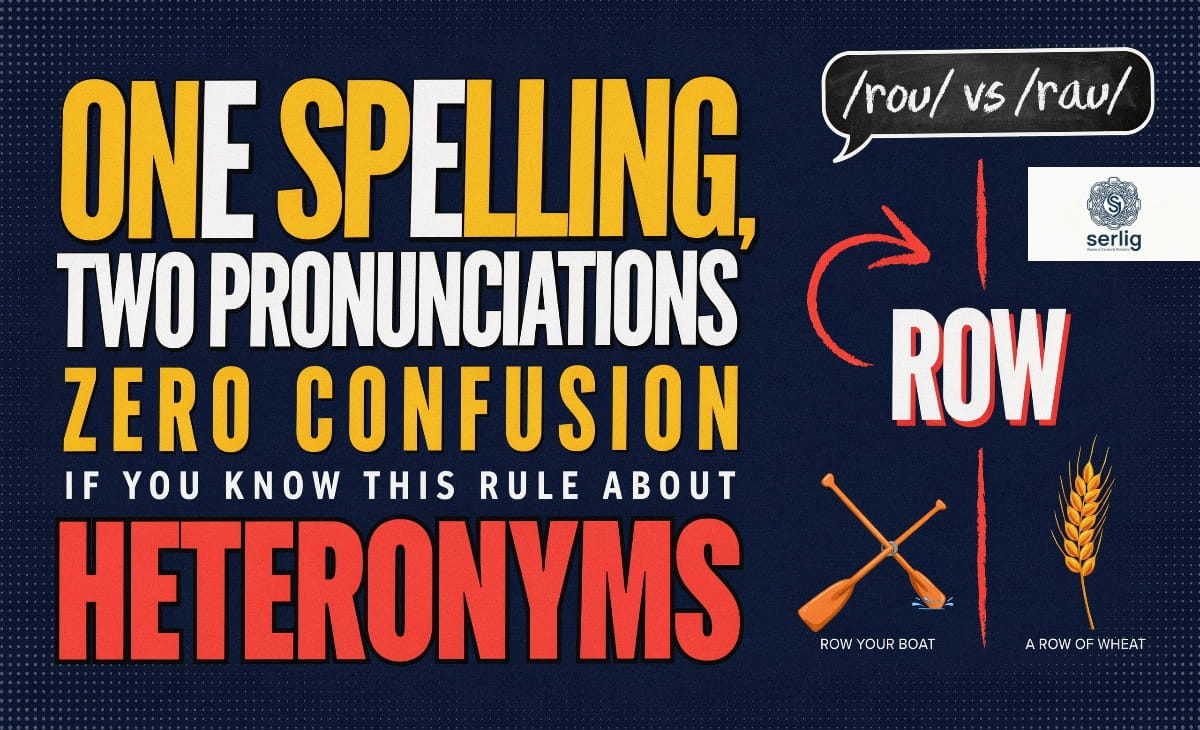
One Spelling, Two Pronunciations, Zero Confusion If You Know This Rule About Heteronyms Row
Language is full of surprises. Few surprises, however, are more delightful — or more puzzling — than heteronyms. Among the best examples linguists and English teachers use is the humble word row. It is spelled identically in both cases. Yet it can be pronounced two different ways. It carries two different meanings. Furthermore, it belongs to two entirely different emotional worlds. Welcome to the topic of heteronyms row — a deep exploration of what heteronyms are, why they exist, and what row tells us about the English language.
Quick Facts Table
| Feature | Row (rhymes with “go”) | Row (rhymes with “cow”) |
| Pronunciation | /roʊ/ | /raʊ/ |
| Part of Speech | Noun / Verb | Noun / Verb |
| Meaning | A line; to propel a boat | An argument; to quarrel |
| Origin | Old English rāw, rōwan | 18th-century British dialect |
| Usage Region | Global English | Primarily British/Irish English |
| Example | “She rowed across the lake.” | “They had a terrible row.” |
What Are Heteronyms?
Before exploring row in depth, it helps to understand the category it belongs to. Heteronyms are words that share the same spelling but differ in both pronunciation and meaning. The term comes from the Greek hetero (different) and onoma (name). It describes a surprisingly common feature of English.
Heteronyms are often confused with two related concepts. First, homophones are words that sound alike but are spelled differently — for example, there, their, and they’re. Second, homographs are words spelled the same but with different pronunciations or meanings. Heteronyms, therefore, are a specific type of homograph where the pronunciation also changes.
The distinction matters. When you read row on a page, the letters give you no clue about which word is intended. Context, tone, and surrounding words do all the heavy lifting. As a result, heteronyms are a rich subject for linguists, language learners, and curious readers alike.
Row (Rhymes with “go”) — The Peaceful Row
The first pronunciation of row rhymes with go, flow, and know. In this sense, it refers to a line or sequence of things arranged side by side. Think of rows of seats in a cinema, rows of crops in a field, or the rows of text on this very page. In short, this row is about order, arrangement, and alignment.
As a noun:
- “She planted tomatoes in neat rows.”
- “We sat in the front row of the theater.”
- “The prisoners stood in a row during roll call.”
As a verb: This pronunciation of row also works as a verb. Specifically, it means to propel a boat using oars. The image is rhythmic and calm — the steady pull of oars through water, the gentle forward motion of a boat.
- “They rowed across the lake before sunrise.”
- “He rowed for the university crew team.”
- “She rowed in silence, watching the mist rise from the river.”
This peaceful row carries connotations of effort joined with tranquility. Rowing a boat is physical work, but it is also meditative. Moreover, the word feels smooth and round in the mouth. The long vowel sound stretches out — much like an oar’s sweep through water.
Row (Rhymes with “cow”) — The Turbulent Row
Then comes the other row — and the mood shifts entirely. This version rhymes with cow, now, and how. It is British English for a noisy argument, a quarrel, or a commotion. It can also refer to a loud, disruptive noise in general.
As a noun:
- “The couple had a terrible row last night.”
- “What’s all that row coming from next door?”
- “The political row over the new budget dragged on for weeks.”
As a verb:
- “They rowed bitterly over whose turn it was to do the dishes.”
- “Stop rowing and try to talk calmly.”
In this pronunciation, row feels sharp and sudden. The short vowel matches the abruptness of conflict. There is, in fact, something almost onomatopoeic about it. The word itself seems to quarrel with its twin. It insists on a different sound, a different identity, and a different emotional world.
Why Does This Happen? The History Behind Heteronyms
The existence of heteronyms like row is not an accident. It is, instead, a direct consequence of how English evolved over more than a thousand years.
English is a famously absorptive language. Over the centuries, it took in vocabulary from Old Norse, Latin, French, German, and dozens of other languages. Often, it kept the spelling of borrowed words while adapting their sounds to fit local pronunciation. Over time, spelling became increasingly standardized — particularly after the printing press arrived in England in the 15th century. Pronunciation, however, kept changing. The result was a growing gap between how words look and how they sound.
The peaceful row traces its roots to Old English rāw (a row or line) and rōwan (to row a boat). The vowel sounds shifted over centuries through the Great Vowel Shift — a massive transformation of English pronunciation that occurred roughly between 1400 and 1700. Consequently, we are left with the long “oh” sound used today.
The quarrelsome row, on the other hand, has murkier origins. Its etymology is less certain. Nevertheless, it appears in British English from the 18th century onward. It was possibly derived from dialectal sources or as a clipping of rouse (meaning to stir up or disturb). Whatever its origins, it settled into a different vowel sound and never merged with its twin.
The result: two identical strings of letters, two radically different words, coexisting on the page like strangers sharing a name.
Heteronyms Row in Practice: The Challenge for Readers and Writers
The practical challenge posed by heteronyms like row is real. For native English speakers, disambiguation is usually automatic. Context resolves the ambiguity before it even registers as a problem. For language learners, however, the process is far more conscious and effortful.
Consider this sentence: “After the row, he took the boat and rowed away.”
A fluent speaker processes this instantly. They shift pronunciation mid-sentence without a second thought. A learner, by contrast, must recognize that the first row (rhymes with cow) signals a quarrel. Meanwhile, the second row in rowed (past tense of the verb) rhymes with go. Two different words appear in the same sentence. They require two different pronunciations stored in memory and retrieved in real time.
This is, therefore, one reason English is notoriously difficult to pronounce from text alone. A language learner cannot simply “sound out” an unfamiliar word and feel confident. They must also know which of several possible pronunciations applies in this specific context.
For writers, moreover, heteronyms create a different challenge: the risk of unintended ambiguity. In written dialogue — especially in fiction — a British character who says “What a dreadful row!” might be misread by an American audience. They may assume the character is commenting on the arrangement of objects rather than expressing frustration about noise or conflict. Therefore, good writers stay aware of their audience’s linguistic expectations. They either choose words carefully or provide enough context to guide interpretation clearly.
Other Famous Heteronyms in English
Row is perhaps the most charming heteronym example because its two meanings are so tonally opposite — one serene, one stormy. However, it is far from alone. English is rich with heteronyms that reward close attention.
Tear — to cry (a tear rolled down her cheek, rhymes with ear) vs. to rip (she tore the letter in half, rhymes with air)
Wind — moving air (the wind blew, rhymes with sinned) vs. to coil or turn (wind the clock, rhymes with kind)
Lead — to guide (he will lead the team, rhymes with feed) vs. the metal (a lead pipe, rhymes with bed)
Close — nearby (the store is close, rhymes with dose) vs. to shut (please close the door, rhymes with nose)
Bow — to bend forward in respect (she took a bow, rhymes with cow) vs. a weapon or ribbon (a bow and arrow, rhymes with go)
Each of these pairs carries the same fundamental puzzle as row: identical spelling, divergent sound, and entirely different worlds of meaning.
Heteronyms and the English Spelling System
The existence of heteronyms is sometimes cited as evidence that English spelling is simply broken — a chaotic accumulation of historical accidents in need of reform. Proponents of spelling reform have, for centuries, argued that English should move toward a more phonetic system. In such a system, each letter or letter combination would consistently represent a single sound.
However, this view misses something important. English’s orthographic complexity is also a record of its history. The spelling row, for instance, preserves two etymological lineages in a single four-letter word. It connects us to Old English oarsmen and 18th-century British quarrellers in a single glance. Strip away the heteronyms, and you strip away some of that richness.
Furthermore, heteronyms like row demonstrate the power of context in human communication. We rarely actually confuse the two meanings in real-life conversation. This is because language is never experienced in isolation. Words arrive embedded in sentences, paragraphs, situations, and relationships. That embedding is almost always enough to guide us to the right meaning and the right sound — entirely without conscious effort.
Teaching Heteronyms Row: A Classroom Perspective
For English teachers, heteronyms like row are invaluable teaching tools. They force students to slow down. They encourage students to think carefully about the relationship between spelling, sound, and meaning. These skills, in turn, transfer broadly to reading comprehension, vocabulary development, and writing quality.
Effective approaches to teaching heteronyms include several strategies. First, sentence pair activities work well. Students read two sentences containing the same word and must identify which pronunciation and meaning applies to each. Second, minimal pair listening exercises train students to hear the difference between row (peaceful) and row (turbulent) in spoken contexts. Third, etymology explorations encourage students to trace the historical roots of each heteronym. This helps them understand why the words diverged. Finally, creative writing prompts ask students to use both pronunciations of a heteronym in the same paragraph. This requires them to control context carefully so readers understand which word is meant.
Conclusion
Row is a small word that carries a large lesson. In its two pronunciations, it captures a core paradox of English. This is a language that looks orderly on the page but sounds entirely different in the mouth. It is a language that values precision but also tolerates — and even cherishes — genuine ambiguity.
The peaceful row, straight and ordered, speaks to our love of structure. The turbulent row, noisy and sudden, speaks to our very human tendency toward conflict and passion. That both versions live inside the same four letters is not a flaw in the language. It is, rather, a feature. It reminds us that words, like people, carry more than one life inside them.
Understanding heteronyms like row, therefore, does not just make you a better speller or a more careful reader. It makes you a more thoughtful user of language — someone who knows that a word on a page is always an invitation to ask which one? and who truly appreciates the richness hiding in the answer.
If you enjoyed this article, check out this related post: Rádiem: The One Czech Word That Says ‘By Radio’ and Carries 100 Years of History With It
FAQs
What is a heteronym? Give an example using “row.”
A heteronym is a word that is spelled the same as another word but has a different pronunciation and meaning. Row is a classic example. Pronounced /roʊ/ (rhymes with “go”), it means a line or the act of paddling a boat. Pronounced /raʊ/ (rhymes with “cow”), it means a noisy argument. Same spelling, two completely different words.
Is “row” a heteronym or a homophone?
Row is a heteronym, not a homophone. Homophones are words that sound the same but are spelled differently — like to, two, and too. Heteronyms, by contrast, are spelled the same but sound different. Since the two versions of row have different pronunciations and different meanings, they are heteronyms.
Why does the word “row” have two different pronunciations?
The two pronunciations of row come from different historical origins. The peaceful row (line / rowing a boat) descends from Old English rāw and rōwan. The argumentative row appeared later, in 18th-century British English, likely from dialectal or informal speech. Both words settled into the same spelling but kept their distinct sounds.
Is the quarrel meaning of “row” used in American English?
Not commonly. The meaning of row as an argument (pronounced /raʊ/) is primarily used in British and Irish English. American English speakers are far more likely to say “argument,” “fight,” or “dispute” instead. So if you are writing for an American audience, using row in this sense may cause confusion.
What are some other common heteronyms besides “row”?
English has many heteronyms. Common examples include tear (a drop from the eye vs. to rip), wind (moving air vs. to coil), lead (to guide vs. the metal), close (nearby vs. to shut), and bow (to bend vs. a weapon or ribbon). Each pair is spelled identically but pronounced differently depending on the meaning intended.