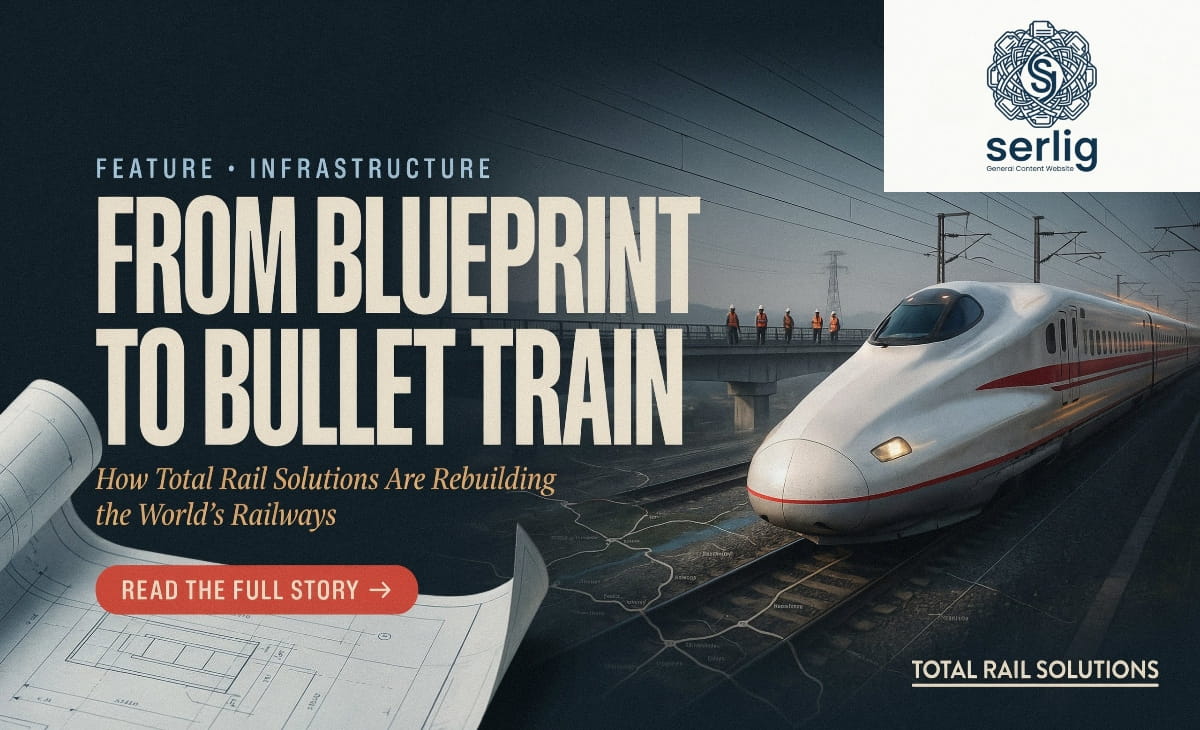
From Blueprint to Bullet Train: How Total Rail Solutions Are Rebuilding the World’s Railways
Rail transport is the backbone of global mobility. It moves millions of passengers and billions of tonnes of freight every day. Furthermore, it does so with a reliability that few transport modes can match. Yet infrastructure is ageing fast. Cities are growing denser. Environmental pressures are also rising sharply. As a result, the railway industry faces a defining moment. The answer is a concept that is reshaping how governments, operators, and investors approach rail: total rail solutions.
Quick Facts Table
| Fact | Detail |
| What it covers | Track, signalling, electrification, rolling stock, digital systems |
| Key benefit | End-to-end accountability under one delivery framework |
| Technology used | Digital twins, BIM, IoT, ETCS, CBTC, AI analytics |
| Global examples | Riyadh Metro, TEN-T Europe, High-Speed Rail Asia |
| Cost advantage | Reduces interface risk, claims, and project delays |
| Lifecycle scope | Planning → Construction → Operations → Renewal |
What Are Total Rail Solutions?
Total rail solutions offer an integrated, end-to-end approach. They cover designing, building, maintaining, and operating railway systems. In contrast to traditional methods, they do not treat each component separately. Track, signalling, rolling stock, electrification, and digital systems all work as one unified ecosystem.
This philosophy emerged from a hard-won industry insight. Fragmented contracting creates inefficiencies, delays, and safety risks. For example, when a signalling contractor and a track supplier work in isolation, their system interfaces become weak points. It close those gaps directly.
The approach covers every phase of a railway project:
- Planning and feasibility studies
- Civil and structural engineering
- Track design, supply, and installation
- Electrification and power supply systems
- Signalling, control, and communications (SCADA, ETCS, CBTC)
- Rolling stock procurement and integration
- Station design and passenger experience
- Maintenance, asset management, and refurbishment
- Digital transformation and smart rail technology
By consolidating these disciplines, total rail solutions offer governments and operators a transformative alternative to the traditional piecemeal approach.
Why Total Rail Solutions Matter Now
The timing of this shift is not coincidental. In fact, several forces are pushing the industry toward integrated models simultaneously.
The Infrastructure Investment Wave
Governments across Europe, Asia, the Middle East, and the Americas are committing record spending to rail. The EU’s TEN-T programme, India’s high-speed rail push, and metro expansions from Riyadh to Sydney represent trillion-dollar investment cycles. Moreover, these programmes demand integrated delivery models. They must manage risk, quality, and schedule across enormous supply chains. Consequently, the case for total rail solutions has never been stronger.
Climate and Decarbonisation Imperatives
Rail is already one of the cleanest forms of mass transport. However, pressure to decarbonise further is intense. Electrifying diesel routes, integrating hydrogen rolling stock, and deploying regenerative braking all cut across traditional contract boundaries. Therefore, a total rail solutions provider models energy use holistically. It optimises the whole network — not just individual components.
Ageing Infrastructure
Many heavily used networks were built in the 19th century. Renewing them while keeping services running is extremely challenging. Without careful coordination, line closures cost operators millions. Fortunately, It providers use digital twins and predictive maintenance platforms. As a result, they schedule interventions precisely when and where they are needed.
Rising Passenger Expectations
Today’s passengers expect seamless digital ticketing and real-time service updates. They also want reliable onboard connectivity and modern rolling stock. Meeting these expectations requires integrating passenger-facing technology with back-office systems. No single discipline can deliver this alone. Thus, an integrated approach becomes essential.
Core Components of a Total Rail Solution
Track Engineering and Infrastructure
The permanent way is the foundation of every railway. It includes track, ballast, sleepers, bridges, tunnels, and earthworks. Total rail solution providers bring together geotechnical specialists and track design experts. Together, they meet demanding specifications for speed, axle load, noise, and longevity.
Modern track engineering uses slab track technology for high-speed and metro applications. It also incorporates embedded rail systems for urban settings. Additionally, advanced rail steel grades extend service intervals and cut lifecycle costs significantly.
Signalling and Train Control
Signalling is the nervous system of any railway. Traditional lineside signals have given way to digital systems like ETCS and CBTC. These systems let trains run closer together safely. As a result, line capacity increases without building new infrastructure.
However, signalling must communicate seamlessly with rolling stock, control centres, and maintenance systems. Poor integration causes performance degradation on busy networks. By contrast, total rail solutions manage these interfaces internally. They eliminate the risk of costly misalignment between systems.
Electrification
The shift from diesel to electric traction is accelerating globally. Environmental policy drives this change, as does the performance advantage of electric trains. Overhead line systems, third-rail systems, and hydrogen hybrids each suit different route types.
It providers manage the full electrification programme. They handle everything from grid agreements to substation installation and depot charging. Moreover, they coordinate all elements to ensure the system works from day one.
Rolling Stock Integration
Trains must work seamlessly with the infrastructure they run on. Wheel profiles, suspension, pantograph geometry, and onboard software all interact closely with track and signalling. Poor coordination between these elements causes expensive late-stage fixes.
Under a total rail solutions model, rolling stock specifications develop alongside infrastructure design. This parallel approach optimises the interface between vehicle and track from the start. Consequently, projects avoid the costly modifications that plague traditional, separately procured programmes.
Asset Management and Maintenance
Delivering a railway on time is only half the challenge. Operating it safely and efficiently for decades requires sophisticated asset management. Total rail solutions extend across the full operational life of an asset.
Digital twin technology has been particularly transformative here. It creates a continuously updated virtual model of the physical railway. Operators use it to simulate maintenance decisions, test timetable changes, and plan renewals years in advance. As a result, they dramatically reduce the cost and disruption of major upgrades.
Total Rail Solutions in Practice: Global Examples
High-Speed Rail Expansion
Countries including Turkey, Saudi Arabia, Morocco, and Indonesia have built high-speed networks using integrated delivery models. These projects required simultaneous delivery of civil works, track, electrification, and rolling stock. Often, they also had to build local rail expertise from scratch. Integrated delivery partners handled all disciplines together. Furthermore, they transferred knowledge and built national capability in the process.
Urban Metro Systems
Cities like Doha, Riyadh, Sydney, and Singapore have expanded metro networks using integrated frameworks. The Riyadh Metro is one of the largest urban transit projects ever completed. It involved six metro lines and more than 85 stations built simultaneously. Managing interfaces across this programme required exactly the kind of holistic thinking that total rail solutions provide.
Network Renewals in Mature Markets
In the United Kingdom, Germany, and Australia, the challenge is modernising existing networks. Total rail solutions providers replace ageing signalling while upgrading track and introducing new rolling stock. Crucially, they do all this while maintaining services on live networks. This demands a level of systems discipline that only an integrated approach can deliver.
Technology as an Enabler
Digital transformation and total rail solutions go hand in hand. Technologies like BIM, digital twins, IoT sensors, and AI are the connective tissue that makes integration possible.
When one provider manages the digital model of an entire railway, data value multiplies. Insights from operations feed back into design. Maintenance data informs renewal planning. Passenger flow analytics shape station layout. In short, total rail solutions create the conditions for this data integration to flourish.
Economic and Commercial Benefits
The commercial case for total rail solutions is strong. Fragmented contracting generates interface risk, claims, and delays. These costs arise at contract boundaries, where responsibility is unclear. Coordination becomes voluntary rather than structural.
Total rail solutions move these interfaces inside one organisation. This aligns incentives and accountability directly. The outcome is faster delivery, lower whole-life cost, and better performance. Additionally, governments gain a single point of accountability. Instead of managing dozens of separate suppliers, they deal with one entity responsible for the whole system.
Conclusion
Total rail solutions represent far more than a procurement model. They represent a fundamental rethink of how railways are built and operated. As technology advances and investment programmes grow, the integrated approach will shift from advantageous to essential.
The railways of the next fifty years will be high-speed, electrified, and digitally connected. They will also integrate seamlessly with multimodal transport networks. Above all, they will be built by organisations that think and act holistically. Total rail solutions provide the framework that turns this vision into reality. For operators, governments, and investors, the message is simple: the future of rail is total.
If you enjoyed this article, check out this related post: video&a: The Future of Interactive Content Marketing and Audience Engagement
Frequently Asked Questions
What does “total rail solutions” mean?
Total rail solutions refer to an integrated approach that covers every aspect of a railway — from planning and civil works to signalling, electrification, rolling stock, and long-term maintenance — under one unified delivery framework.
Why are total rail solutions better than traditional contracting?
Traditional contracting splits a railway project among many separate suppliers. This creates gaps at system interfaces, leading to delays, cost overruns, and safety risks. Total rail solutions manage all interfaces internally, reducing these problems significantly.
Which technologies support total rail solutions?
Key technologies include digital twins, Building Information Modelling (BIM), IoT condition sensors, AI-powered predictive maintenance, ETCS/CBTC signalling platforms, and advanced data analytics systems.
Are total rail solutions suitable for smaller or regional rail projects?
Yes. While they are especially valuable for large, complex programmes, the integrated principles of total rail solutions apply at any scale. Even regional rail renewals benefit from coordinated design, systems integration, and lifecycle asset management.
How do total rail solutions support sustainability goals?
By managing electrification, energy systems, and rolling stock as an integrated whole, total rail solutions optimize energy consumption across the entire network. This makes it easier to meet decarbonisation targets and introduce low-emission technologies like hydrogen trains and regenerative braking.