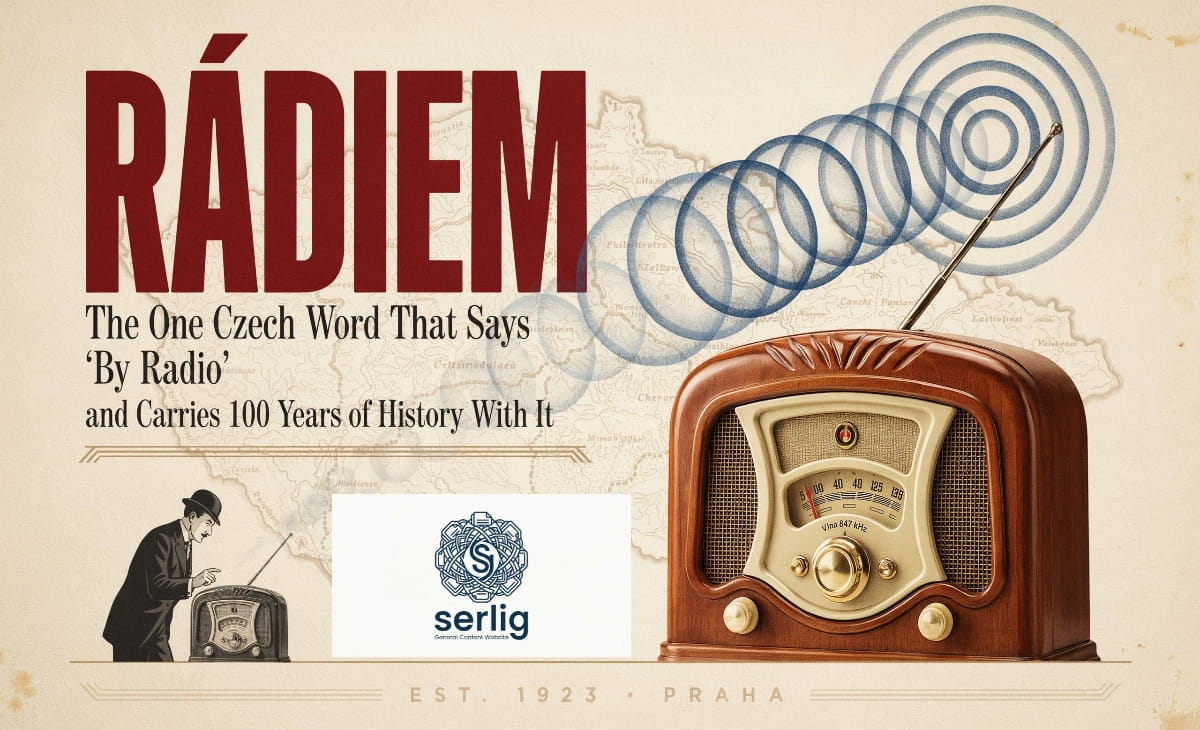
Rádiem: The One Czech Word That Says ‘By Radio’ and Carries 100 Years of History With It
Language surprises you in small places. A single word can hold grammar, history, and emotion all at once. Rádiem is exactly that kind of word. Czech and Slovak speakers use it every day without giving it a second thought. Yet for anyone studying language, communication, or Central European culture, rádiem opens a remarkable window.
This article covers the full story — what rádiem means, how its grammar works, where it came from, and why a word born in the early twentieth century still carries weight in the digital age.
Quick Fact Table
| Feature | Detail |
| Word | Rádiem |
| Language | Czech & Slovak |
| Base Word | Rádio (radio) |
| Grammatical Form | Instrumental singular |
| English Meaning | “By radio” / “Via radio” / “Through radio” |
| Latin Root | Radiēs (ray) |
| First Regular Broadcast | May 18, 1923 — Prague-Kbely, Czechoslovakia |
| Case System | 7 grammatical cases in Czech grammar |
| Key Distinction | Rádiem = method; V rádiu = location |
| Still in Active Use? | Yes — in everyday speech, emergency services, media |
What Does Rádiem Mean?
Rádiem is a Czech and Slovak word. Its English meaning is “by radio,” “via radio,” or “through radio.” It does not refer to the radio device itself — that word is rádio. Instead, rádiem tells you how something happened. It names radio as the tool or method of communication.
Czech and Slovak speakers use it in sentences like “Slyšel jsem to rádiem” — “I heard it by radio.” Another common example is “Poslouchám zprávy rádiem” — “I listen to the news by radio.” In both cases, rádiem replaces the English phrase “by radio” with a single, compact form.
English needs prepositions like “by,” “via,” or “through” to express this idea. Czech and Slovak take a different route — they change the ending of the noun itself. That single change in ending carries the full meaning of the method. This is not a special trick or an exception. It reflects how these languages work at the core level.
The Grammar Behind Rádiem: Understanding the Instrumental Case
Czech grammar uses seven grammatical cases. Each case gives a noun a different ending. That ending shows the noun’s role in the sentence. One case marks the subject. Another marks the direct object. A third shows possession. The system works efficiently because the ending itself carries the grammatical information.
Rádiem uses the instrumental case — the form Czech and Slovak use to express a tool, method, or means. When radio becomes the instrument of an action, the word rádio shifts to rádiem. The ending changes; the meaning expands.
In English, you need a prepositional phrase to express the same idea: “by means of the radio,” “using the radio,” “through the radio.” In Czech or Slovak, one word handles all of that. This efficiency makes the language compact and precise.
One comparison helps clarify things further. Rádiem uses the instrumental case and expresses how something travels — the method of transmission. V rádiu, by contrast, uses the locative case and refers to where content appears — something heard on the radio. Both forms grow from the same root. Each carries a distinct grammatical job. The difference is subtle in English translation but clearly marked in Czech and Slovak sentence structure.
The Etymology: Where Did the Word Rádio Come From?
The word rádio entered Czech and Slovak in the early twentieth century. It came through French and English routes, drawing ultimately from the Latin word radiēs, which means “ray.” That same Latin root produces radiation, radiant, and the chemical element radium.
Early scientists pictured electromagnetic waves as invisible rays moving through space. Guglielmo Marconi built on that concept when he carried out the first successful long-distance wireless transmission in 1895. The technology took the name “radio” across most European languages, and Czech and Slovak adopted the term just as the medium was spreading across the continent.
What Czech and Slovak then did with the word reveals something important about Slavic grammar. Rather than leaving rádio as a fixed, unchangeable foreign term, speakers integrated it fully into the case system. The noun rádio behaved like any other neuter noun. When the instrumental case was required, it became rádiem. The same logic applies to auto (car), which becomes autem in the instrumental — “by car.” Foreign words do not stay foreign for long in these languages. The grammar absorbs and transforms them.
The History of Radio in Czech and Slovak Lands
Understanding the word rádiem means understanding what radio meant — and still means — to people in the Czech and Slovak regions.
The First Broadcasts
Radio experiments in what would become Czechoslovakia began even before the First World War. The first formal radio programme, combining spoken words and music, went out on October 28, 1919. Engineers broadcast it from the telegraph station at Prague’s Petřín Lookout Tower — on the first anniversary of Czechoslovak independence. A new nation and a new technology announced themselves on the same day.
Regular scheduled broadcasting started on May 18, 1923, from a military tent in Prague-Kbely. The equipment was basic. A telegraph transmitter handled Morse code during the day. In the evenings, workers connected it to a makeshift modulator with a microphone. From there, voice and music went out over the airwaves. That tent became the first broadcast studio. Against all expectations, Czechoslovakia became the second country in Europe — after the United Kingdom — and the third country in the world to run regular radio broadcasts.
Three men drove that achievement. Miloš Čtrnáctý, a journalist, provided editorial leadership. Eduard Svoboda brought business experience. Ladislav Sourek, director of Radioslavia — the first Czech company selling radio equipment — understood the technology. Together, they founded Radiojournal, Czechoslovakia’s first radio operator. At launch, broadcasts ran for just one hour per day: a brief introduction followed by live music.
Growth and Expansion Through the 1920s and 1930s
The 1920s brought rapid change. By 1924 — only one year into regular broadcasting — Czech speakers coined their own native word for “broadcasting”: rozhlas. This term gradually replaced foreign expressions like “radiophony” and “wireless telegraphy.” The language was catching up with the technology it had helped create.
By 1925, a new broadcasting station built by General Electric with a 5-kilowatt output made Czechoslovakia home to one of Europe’s most powerful transmitters. Long-distance tests confirmed that signals reached listeners as far away as North America.
International broadcasting began in 1936 as political tensions across Europe intensified. Czechoslovakia launched foreign-language radio services specifically to counter propaganda and maintain contact with audiences abroad. That founding mission continues today through Radio Prague International and Radio Slovakia International.
Radio During War and Crisis
Radio proved its true importance during moments of national crisis. During the Nazi occupation of Czechoslovakia, clandestine broadcasts kept resistance networks informed and connected national spirit to the outside world. On May 5, 1945, a message on Czech Radio helped trigger the Prague Uprising against Nazi forces — a direct demonstration that radio was not entertainment but a weapon of survival.
The events of 1968 showed radio’s power again. When Soviet-led forces invaded Czechoslovakia on August 21, 1968, broadcasters at the Czechoslovak Radio building in Prague refused to stop transmitting. Fifteen citizens and radio employees died defending the building against Soviet forces. Even after the building fell, broadcasting continued from other locations. Rádiem — “by radio” — described a lifeline in the most literal sense during those hours.
These experiences made radio something more than a medium. For Czech and Slovak people, it became a symbol of resistance, independence, and national identity. Every use of rádiem since then carries traces of that history.
How Rádiem Appears in Modern Use
Despite smartphones, streaming, and on-demand audio, rádiem remains part of active Czech and Slovak vocabulary today.
Everyday Conversation
Native speakers use the word naturally and without effort. Common expressions include “Zprávu jsem dostal rádiem” (“I received the message by radio”), “Poslouchám hudbu rádiem” (“I listen to music by radio”), and “Bylo to oznámeno rádiem” (“It was announced over the radio”). None of these sound old-fashioned to Czech or Slovak ears. They reflect the standard way the language describes radio as a method.
Professional and Technical Writing
Aviation, maritime communications, emergency services, and military operations all rely on radio as a primary communication tool. Czech and Slovak professionals working in these fields use rádiem in technical documentation, operational reports, and training manuals. Emergency services coordinate rádiem. Air traffic controllers receive pilot transmissions rádiem. Coast guard vessels send distress signals rádiem. Where reliable real-time communication matters most, radio endures — and so does the word that names it as a method.
Media and Journalism
Journalists and media professionals use rádiem regularly when discussing how information travels. A reporter might note that breaking news spread rádiem before television or online outlets picked it up. A media historian might compare interviews conducted rádiem against those recorded in person. The word fits naturally into professional writing about communication history and practice.
Rádiem, Nostalgia, and Cultural Memory
Language stores emotion alongside information. For many Czech and Slovak speakers, rádiem does not just describe a communication method. It conjures a feeling.
Radio holds a warm place in Central European cultural memory. Families gathered around radio sets to hear the news, folk music, theatre broadcasts, and live sports. Children fell asleep to bedtime stories read rádiem. Major political events reached people rádiem before any other channel existed. Liberation — and occupation — arrived rádiem.
Phrases built around rádiem often carry nostalgia as a result. Hearing something rádiem brings back associations with a specific era — the hiss of an analogue signal, the particular warmth of radio voices, the shared attention of a family around a glowing set. That atmosphere does not disappear because streaming services exist. It lives inside the language.
The emotional weight of rádiem is especially strong given how often radio marked turning points in Czech and Slovak national history. The word works as a compact carrier of collective memory — a small form holding an enormous past.
Rádiem in the Digital Age
Radio has changed dramatically since 1923. Analogue AM and FM signals gave way to digital DAB broadcasting, internet radio, satellite transmission, and hybrid platforms. Despite all of that, rádiem has not become obsolete. It remains the correct and natural instrumental form in Czech and Slovak, covering any version of radio — analogue or digital, terrestrial or online.
This staying power reflects something true about grammar. Case structures express relationships between ideas — tool, method, means — rather than naming specific technologies. The instrumental case does not care whether the signal travels through copper wire or Wi-Fi. It cares only that radio is the method. As long as radio exists in any form, rádiem remains the right word to describe using it.
Digital radio services, internet streams marketed as radio stations, and hybrid broadcasting systems all generate new contexts for rádiem. Listeners describe tuning into a station rádiem even when the audio arrives through a broadband connection. The word adapts because the grammar adapts. That flexibility has kept rádiem alive through a century of technological change.
What Rádiem Teaches Us About Language
Rádiem rewards attention because it teaches several things at once.
It shows how Slavic grammar works. Czech and Slovak encode the relationship between an action and its instrument directly into the word form. English speakers rely on separate prepositions. Slavic speakers rely on endings. Both systems work, but the Slavic approach produces remarkable compactness.
It shows how languages absorb foreign words. Rádio arrived from international scientific vocabulary but entered the Czech and Slovak case system immediately. Rádiem is the proof — a borrowed word behaving exactly like a native one.
It shows how technology shapes vocabulary permanently. Radio’s arrival in the early twentieth century produced grammatical forms that have now lasted over a hundred years. Technology changes. The language it creates often outlasts the original technology.
It shows that small words carry large histories. Every Czech or Slovak speaker who says rádiem uses a form connected to national broadcasts, wartime resistance, political crises, and family memories. Grammar and history share the same space inside a single word.
Conclusion: Why Rádiem Still Matters
Rádiem is far more than a translation of “by radio.” It demonstrates how Czech and Slovak grammar operates with precision and economy. It connects to more than a century of broadcasting history in Central Europe, carries cultural memory, emotional resonance, and linguistic heritage inside five letters and one accent mark.
From a tent in Prague-Kbely in 1923 to digital streams in 2026, radio has stayed relevant — and rádiem has stayed with it. Whether you encounter the word in a grammar textbook, a historical archive, an emergency services manual, or a casual conversation, you now know what it carries. That small instrumental form does exactly what the best language always does: it says everything it needs to say, and nothing more.
Here’s another article you might find valuable: Laaster: Meaning, Origins, Cultural Significance, and Modern-Day Relevance
Frequently Asked Questions
What does rádiem mean in English?
Rádiem translates to “by radio,” “via radio,” or “through radio” in English. It is the instrumental singular form of the Czech and Slovak word rádio, used to express radio as the method or means of communication in a sentence.
Is rádiem used in both Czech and Slovak?
Yes. Both Czech and Slovak use rádiem with the same meaning and the same grammatical function. Since the two languages share closely related case systems, the instrumental form of rádio is identical in both — making it straightforward for learners studying either language.
What is the difference between rádiem and v rádiu?
Rádiem uses the instrumental case and answers the question “by what method?” — it identifies radio as the means of transmission. V rádiu uses the locative case and answers “where?” — it refers to content appearing or broadcasting on the radio. One expresses method; the other expresses location.
Is rádiem still relevant in the digital age?
Absolutely. Although radio technology has shifted from analogue to digital and internet-based platforms, rádiem remains the standard instrumental form in Czech and Slovak for describing radio as a communication method. The grammatical case structure applies regardless of how the signal travels — through airwaves or broadband.