Why Lights Look Like Starbursts at Night — The Astigmatism Effect Nobody Talks About
Have you ever looked at a streetlight and seen it explode into a starburst? Or watched oncoming headlights bloom into blinding halos that swallow the road ahead? If so, you may have astigmatism. This is one of the most striking — and disorienting — symptoms of this common refractive error. Understanding why it happens, what it looks like, and how to manage it can make a huge difference in daily life, especially after dark astigmatism lights.
Quick Facts: Astigmatism and Lights
| Feature | Detail |
| Condition | Astigmatism (refractive error) |
| How Common | Affects ~1 in 3 people worldwide |
| Main Light Symptoms | Halos, starbursts, streaks, ghosting, glare |
| Worst Time | Night / low-light environments |
| Biggest Risk | Night driving safety |
| Top Fixes | Glasses, toric contacts, LASIK |
| Diagnosed By | Optometrist or ophthalmologist |
| Reversible? | Yes — fully correctable in most cases |
What Is Astigmatism?
Astigmatism is a refractive error caused by an irregular curvature of the cornea or lens. In a healthy eye, the cornea is spherical — like a perfect basketball. It bends light cleanly onto the retina as a single sharp point. In an eye with astigmatism, the cornea is shaped more like an American football. It curves more steeply in one direction than another. This uneven surface scatters incoming light. Instead of one focus point, light hits multiple points. The result is blurred or distorted vision at all distances.
How Common Is It?
Astigmatism is remarkably common. The American Optometric Association estimates it affects roughly one in three people. It often coexists with myopia (nearsightedness) or hyperopia (farsightedness). It can be present from birth or develop gradually over time. Many people have mild astigmatism and barely notice it. Others experience significant disruption — especially when lighting conditions change.
Why Astigmatism Makes Lights Look Strange
The most dramatic symptom of astigmatism is the way it distorts light sources. The cornea bends light unevenly. Instead of focusing a point of light into a single crisp dot on the retina, it smears that light along the axis of the distortion. People with astigmatism commonly report several distinct visual effects:
Starbursts
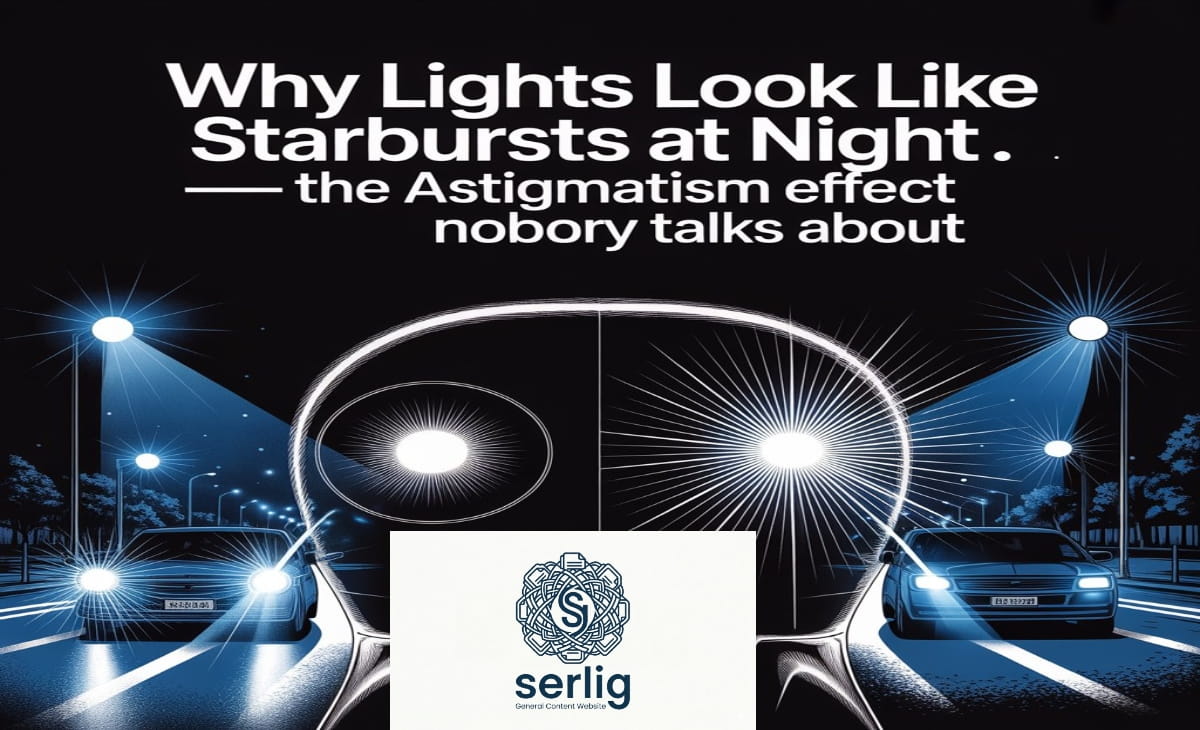
Light sources shoot out spikes or rays in multiple directions. This looks like a star drawn by a child. It is caused by the irregular corneal surface diffracting light outward from the source.
Halos
A soft, glowing ring surrounds bright lights. This is distinct from the starburst effect. It often appears around traffic lights or illuminated signs in low-contrast environments.
Streaks
Lights seem to smear or trail in one direction. A person might see a horizontal bar extending from every headlight. The direction of the streak matches the axis of the corneal irregularity.
Ghosting
A secondary, offset image of a light source appears beside the primary one. Bright objects get a ghost-like double outline.
Glare
Bright lights spread excessively. This makes it hard to see anything near the light source clearly. LED headlights are a particularly common trigger.
Why Night Makes Everything Worse
All of these effects get much worse in low light. In dim environments, the pupil dilates to let in more light. A wider pupil exposes more of the irregular corneal surface. This amplifies every distortion. In bright daylight, the contracted pupil blocks most of the uneven corneal area. The effects shrink dramatically as a result.
Astigmatism Lights vs. Normal Vision
People without astigmatism see light sources as clean, compact shapes. A headlight is a bright oval. A streetlamp is a distinct sphere. A candle flame is a small teardrop.
People with uncorrected astigmatism see something far more complex. Those headlights expand into spreading halos. They merge with other lights on the road. Individual cars become hard to isolate. The streetlamp may look like a glowing cross or starburst. The candle flame may ghost into two overlapping images.
A Simple Self-Test
Try this at home. Look at a single point of light in a dim room. If it looks crisp and sharp, your cornea is likely working uniformly. If it appears blurred, smeared, or surrounded by a glow, astigmatism may be a factor. A formal eye exam is always the best confirmation.
Night Driving: The Most Common Complaint
Of all daily situations, night driving is where astigmatism causes the most real-world problems. Night driving already demands a lot from the visual system. There are moving hazards, sudden changes in illumination, and low contrast between pedestrians and background. Astigmatism makes every one of these challenges harder.
What Drivers With Astigmatism Experience
Oncoming headlights — especially modern blue-white LEDs — bloom into large halos. These can temporarily blind a driver to the road between them. Traffic signals blur into diffuse colored glows. Lane markings lose definition. Cyclists and pedestrians can disappear into scattered light.
The Safety Risk
This is not just an inconvenience. Uncorrected refractive errors are a documented risk factor for nighttime driving accidents. If you struggle far more at night than during the day, book a comprehensive eye exam. If other drivers seem unbothered by glare that overwhelms you, that gap deserves investigation.
Other Conditions That Cause Similar Light Effects
Astigmatism is not the only cause of strange light perception. Several other conditions produce similar symptoms. Telling them apart matters.
Cataracts: The lens becomes cloudy with age. It scatters light and produces halos. Unlike astigmatism, cataracts worsen progressively and affect color and brightness perception overall.
Dry Eye Disease: A poor tear film leaves the corneal surface irregular. This temporarily produces distortion similar to astigmatism. The blurring from dry eye fluctuates. It improves after a blink and worsens after prolonged screen use.
Glaucoma: High intraocular pressure can cause halos due to corneal swelling. Acute angle-closure glaucoma is a medical emergency. Sudden halo vision with pain, nausea, or headache requires immediate care.
Post-Surgical Changes: LASIK and similar procedures can cause halos and starbursts. These often improve as the eye heals, but may persist in some cases.
If you notice sudden or new changes in light perception — especially with pain, redness, or vision loss — see a doctor immediately. Stable, long-term symptoms are far more likely to be astigmatism.
Diagnosis and Correction
How Astigmatism Is Diagnosed
Diagnosis is straightforward. It is part of any standard eye exam. Your optometrist measures corneal curvature using keratometry. In complex cases, a corneal topographer maps the full surface shape. A refraction test completes the picture. You look through lenses and report which gives the clearest view.
The prescription involves three numbers. Sphere power corrects any myopia or hyperopia. Cylinder power indicates the degree of astigmatism. Axis describes the orientation of the irregularity in degrees from 0 to 180. All three must be precise for the correction to work.
Eyeglasses
Glasses are the simplest option. Cylindrical lenses compensate for uneven corneal curvature. They bring light to a single point of focus. Most people find their light distortion disappears almost entirely with the right glasses.
Toric Contact Lenses
Toric lenses are designed specifically for astigmatism. They have different powers in different meridians. A weighted or prism-ballasted design stops them from rotating on the eye. They work well for most people. Both daily disposable and reusable formats are available.
Orthokeratology (Ortho-K)
Ortho-k lenses are rigid gas-permeable lenses worn overnight. They temporarily reshape the cornea. The result is clear daytime vision without any correction. This option is popular with athletes and people who cannot wear lenses during certain activities.
Refractive Surgery
LASIK, LASEK, PRK, and SMILE all permanently reshape the cornea. Modern laser systems handle astigmatism with high accuracy. They address both degree and axis precisely. Not everyone qualifies for surgery. Each procedure carries its own risks. Discuss all options carefully with a specialist.
Tips for Managing Astigmatism and Light Sensitivity
Optical correction is the primary solution, but these practical steps also help:
Wear your full correction at night. Daytime vision may feel adequate without glasses. But nighttime distortion is amplified. Full correction matters much more after dark.
Choose anti-reflective (AR) lens coatings. AR coatings reduce internal lens reflections. They cut glare and scatter significantly. They are one of the most impactful upgrades for night driving comfort.
Be cautious with yellow-tinted lenses. These are marketed for night driving. They may improve perceived contrast in some conditions. However, they reduce overall light transmission. Most eye care professionals do not universally recommend them.
Reduce screen brightness in dark rooms. Bright screens in dark environments are particularly uncomfortable with astigmatism. Enable night mode. Raise ambient room lighting during evening screen use.
Keep your prescription up to date. Astigmatism changes over time — especially during adolescence, pregnancy, or aging. An outdated prescription corrects last year’s cornea, not this year’s.
When to See an Eye Care Professional
If you recognize any of these symptoms — halos, starbursts, streaks, or ghosting around lights — book a comprehensive eye exam. Many people only discover their uncorrected astigmatism after an exam. They assumed their distorted light perception was simply normal.
Astigmatism’s effects on light are not cosmetic inconveniences. They affect road safety, workplace comfort, and quality of life wherever artificial lighting exists. The good news: astigmatism is one of the most readily correctable conditions in eye care. The right prescription can eliminate halos and starbursts almost entirely. That answer may be one appointment away.
Conclusion
Astigmatism changes the way you see every light source around you. Streetlamps become starbursts. Headlights become halos. Night driving turns stressful. The root cause is a simple corneal irregularity — and it is highly treatable. Whether you choose glasses, toric contacts, or laser surgery, effective correction exists for nearly every case. If lights look strange to you at night, do not ignore it. Schedule an eye exam, get the right prescription, and reclaim a world that is clear, sharp, and free of unwanted glow.
Continue reading with this related post: Diag Image: A Complete Guide to Diagnostic Imaging in Modern Medicine
Frequently Asked Questions
Can astigmatism make lights look like starbursts?
Yes. Astigmatism causes the cornea to scatter light unevenly. Instead of focusing a point of light into a single dot, it spreads it outward. This produces the classic starburst effect — spikes of light radiating from a source like a lamp or headlight.
Why do lights look worse at night with astigmatism?
At night, your pupils dilate to let in more light. A wider pupil exposes a larger area of the irregular corneal surface. More of the distortion comes into play. Halos, streaks, and starbursts become much more pronounced in low-light conditions.
Can glasses fix astigmatism light distortion?
Yes, in most cases completely. Prescription glasses with cylindrical lenses compensate for the irregular corneal curvature. They bring light to a proper focus. Most people report that halos and starbursts disappear when wearing their correct prescription.
Is astigmatism the only cause of halos around lights?
No. Cataracts, glaucoma, dry eye disease, and post-LASIK changes can all produce halo effects. Cataracts tend to worsen progressively with age. Glaucoma halos may come with eye pain. Dry eye halos fluctuate with blinking. An eye exam is the best way to identify the true cause.
Is astigmatism dangerous if left untreated?
Astigmatism itself does not damage the eye. However, leaving it uncorrected affects quality of life and safety. Night driving with uncorrected astigmatism is a documented safety risk. Eye strain, headaches, and difficulty concentrating are also common. Correction is simple, effective, and strongly recommended.