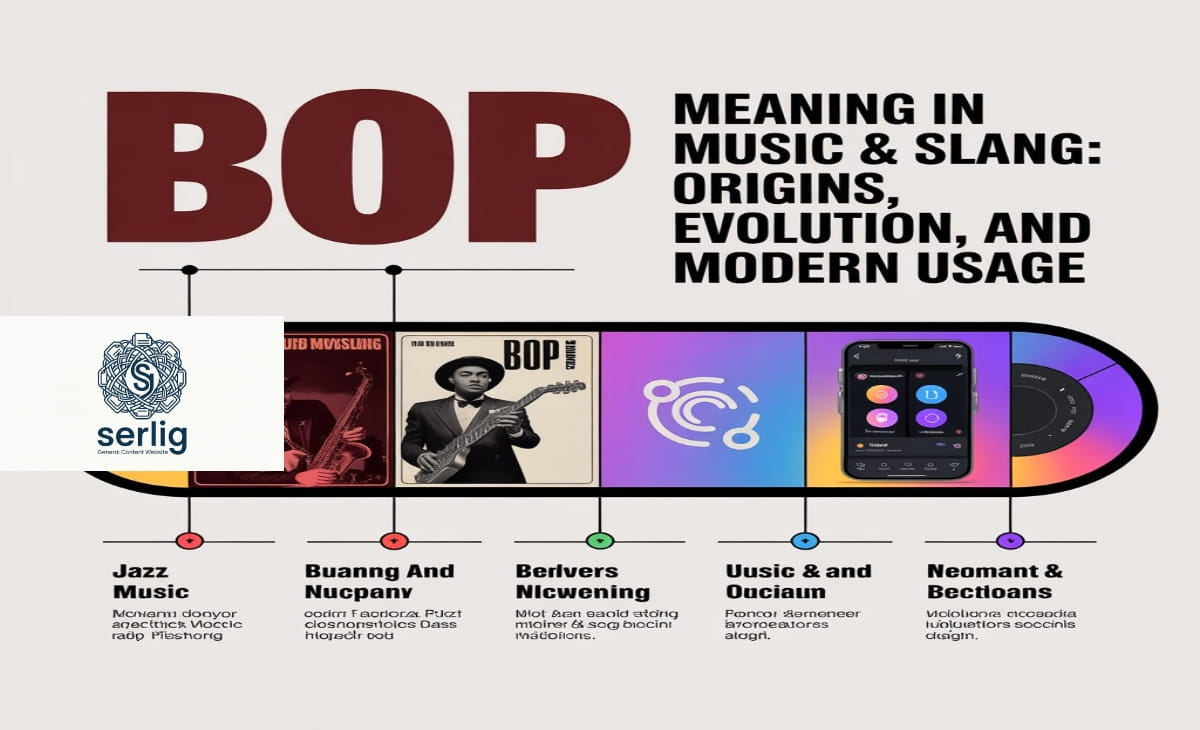
Bop Meaning in Music & Slang: Origins, Evolution, and Modern Usage
If you’ve ever scrolled through social media and seen someone comment “this is a bop” under a music video, you’ve encountered one of the most beloved slang terms in modern pop culture. But the word bop meaning is far older, richer, and more layered than its current viral life might suggest. From bebop jazz clubs in 1940s Harlem to TikTok comment sections in 2024, the journey of “bop” is a fascinating story about how language evolves, migrates, and takes on new life with every generation.
This article breaks down every dimension of the word — its origins, its musical roots, its slang meaning, its use as a verb, and why it has become one of the most versatile and enduring words in the English language.
What Does “Bop” Mean? The Short Answer
The word bop meaning has several distinct meanings depending on context:
- A great song — In contemporary slang, a “bop” is a track that’s undeniably catchy, energetic, and fun to listen to. “That new song is an absolute bop.”
- A style of jazz — “Bop” is short for bebop, the complex, fast-paced jazz style that emerged in the 1940s.
- To hit or strike — As a verb, “to bop” someone means to give them a light hit or punch.
- To dance — “Bopping” can mean dancing, especially in a carefree, rhythmic way.
- To move — Informally, “bopping around” means moving from place to place in a relaxed manner.
Each of these meanings has its own history and context, and together they paint a portrait of a word with remarkable staying power.
The Origins of Bop: Jazz and Bebop
To understand “bop,” you have to go back to post-World War II America, specifically to the jazz scene flourishing in cities like New York, Chicago, and Kansas City.
In the early 1940s, musicians like Charlie Parker, Dizzy Gillespie, Thelonious Monk, and Miles Davis were growing restless with the smooth, accessible sound of swing. They wanted something more complex — music that challenged both the performer and the listener. What emerged from late-night jam sessions and rehearsals was bebop, a revolutionary style of jazz defined by rapid tempos, intricate chord progressions, and improvisation that pushed the limits of what musicians could technically execute.
“Bebop” is itself thought to be an onomatopoeic term — it mimics the sound of the music’s characteristic two-note melodic phrases. “Bop” became the shortened, street-ready version of the word. By the mid-1940s, the jazz community was using “bop” both as a genre label and as a verb describing the act of playing or dancing to this energetic new sound.
The cultural significance of bebop — and by extension, “bop” — cannot be overstated. It represented a conscious artistic statement by Black American musicians who were reclaiming jazz as a serious art form rather than just dance-floor entertainment. It was cerebral, fast, and deliberately complex. To call something a “bop” in this original context was to acknowledge something that moved you, challenged you, and demanded your attention.
Bop as a Verb: Hitting, Dancing, and Moving
Long before “bop” became music slang, it had a simpler, more physical meaning: to hit. The use of “bop” to describe a light strike or punch dates back to at least the early 20th century. If you “bopped” someone on the nose, you gave them a quick, not necessarily serious, hit. It has a cartoonish, playful quality — the kind of word that fits perfectly in a comic strip or slapstick scene.
This sense of playful physical action likely contributed to the word’s natural migration toward dancing. To “bop” on a dance floor is to bounce, sway, and move in a loose, joyful way. There’s an inherent rhythm to the word itself — the single hard consonant sound packs a punch (literally) that makes it perfect for describing movement with energy.
By the 1950s and 1960s, “bopping” was widely used to describe casual, free-form dancing. Teenagers would “bop” at sock hops and school dances. The word carried a sense of youth, freedom, and spontaneity — qualities that have followed it ever since.
“Bopping around” also entered everyday speech as a way to describe casual, aimless movement from place to place. Someone might say they’ve been “bopping around town,” meaning they’ve been moving through different spots without any rigid agenda. This usage is relaxed and conversational, and remains common today.
Modern Slang: “That’s a Bop”
Here’s where things get interesting for the internet generation. Sometime in the 2010s, “bop” underwent a slang renaissance. Rather than fading into the background like many jazz-era terms, it was picked up by music fans — particularly in hip-hop, R&B, and pop communities — and repurposed to mean something very specific: a great, catchy song.
When someone calls a track a “bop,” they’re saying it has an irresistible quality. It makes you want to move, sing along, or turn up the volume. A bop isn’t necessarily a critically acclaimed masterwork — it’s more about feeling than prestige. A song can be objectively silly and still be a bop. In fact, some of the most legendary bops are tracks that nobody would call high art but that everyone knows every word to.
The word’s rise in this context was boosted enormously by social media. Twitter (now X), Instagram, and especially TikTok made “bop” a staple of music commentary. Comment sections filled with “this is a bop,” “absolute bop,” “okay, this slaps — certified bop,” and similar phrases. The word is democratic and enthusiastic — it doesn’t come with the weight of genre loyalty or critical gatekeeping. Pop fans, rap fans, country fans, and EDM fans all use it freely.
What makes “bop” particularly powerful as slang is its universality and brevity. It’s one syllable. It packs a complete emotional response — joy, validation, energy — into a single word. Few compliments in the music world are as instantly understood.
Bop vs. Slaps vs. Bangers: The Slang Ecosystem
“Bop” doesn’t exist in isolation. It shares the complimentary music-slang space with words like “slaps,” “banger,” “fire,” and “heat.” It’s worth distinguishing how they differ:
- Slaps: Slightly more intense than a bop, often implying the song has bass-heavy energy or hits particularly hard. West Coast hip-hop culture popularized this term.
- Banger: Usually implies a high-energy track designed for clubs or parties. Bangers tend to be louder, faster, and more aggressive.
- Fire / Heat: General terms for anything excellent, not limited to music.
- Bop: The most wholesome of the group. A bop can be soft, mid-tempo, or even a little corny — it just has to be undeniably catchy and fun.
The distinction matters because it reveals what “bop” actually celebrates: pure listenability. You don’t need a drop, a heavy bass line, or even a complex arrangement. You just need a song that makes people feel something good.
Cultural Significance: Why “Bop” Has Lasted
Language is always in flux, but most slang terms flame out within a few years. “Bop” has defied this pattern. Why?
Part of the answer lies in its phonetic charm. Single-syllable words with hard consonants are naturally expressive. The “b” sound is punchy; the short “o” is round and satisfying; the final “p” gives it a decisive snap. The word sounds like what it means — something quick, bright, and impactful.
Another factor is the word’s flexibility across generations. Baby boomers who remember bebop, Gen Xers who bopped at school dances, millennials who first heard the modern slang usage, and Gen Z TikTok users all have a relationship with “bop.” Its multiple meanings allow it to be claimed authentically by very different groups without contradiction.
Finally, “bop” survives because music itself is eternal. As long as people are discovering and sharing songs, they’ll need a word that captures the excitement of a truly great track. “Bop” fills that role beautifully.
Bop in Pop Culture References
The word has also embedded itself in pop culture titles and references. Doja Cat, Cardi B, and countless other artists have used “bop” in lyrics and interviews. The word appears in song titles, album reviews, and music journalism regularly. When publications list their favorite songs of the year, you’ll often see “bops” in the headline.
There’s also the beloved tradition of the “bop of the day” — social media posts, newsletters, and playlists dedicated to surfacing one standout track. This framing treats the word almost like a certification: this song has been evaluated and deemed worthy of the title.
Bop as a Proper Noun
“Bop” has also taken on life as a proper noun in various contexts. Brands, music blogs, and playlists have adopted the name. It signals a certain identity: fun, music-forward, culturally fluent. Using “Bop” in a name is a shorthand for saying you have good taste and don’t take yourself too seriously — which is, incidentally, exactly what the best bops do.
Conclusion: A Word That Moves Like the Music It Describes
From smoky jazz clubs to digital comment sections, “bop” has traveled an extraordinary distance while somehow staying true to its essence. At its core, the word has always been about movement and joy — the kind of uncontrollable nodding, swaying, or dancing that a great piece of music can provoke.
Whether you’re using it to describe Charlie Parker’s lightning-fast saxophone runs, your nostalgic shuffle from one venue to another, a cartoonish tap on the head, or that pop song you’ve had on repeat for three days straight, “bop” delivers. It is expressive without being pretentious, enthusiastic without being exhausting, and brief without being empty.
The next time a song comes on and you feel that involuntary urge to move — that’s a bop. And now you know exactly why.
Don’t miss this related article on a similar topic: Toastul: The Complete Guide to the Toast Trend Taking Over Modern Food Culture
FAQs
What does “bop” mean in slang?
In slang, a “bop” is a catchy, fun, and energetic song that makes you want to dance or replay it repeatedly.
Where did the word “bop” originally come from?
It comes from “bebop,” a fast-paced jazz style from the 1940s led by artists like Charlie Parker and Dizzy Gillespie.
Is “bop” only used for music?
No. It can also mean to hit lightly, dance casually, or move around in a relaxed way.
How is “bop” different from “banger” or “slaps”?
A “bop” is more light, catchy, and fun, while “banger” and “slaps” usually describe heavier, high-energy tracks.
Why is the word “bop” still popular today?
Because it’s simple, expressive, and versatile—perfect for describing music across generations and social media trends.