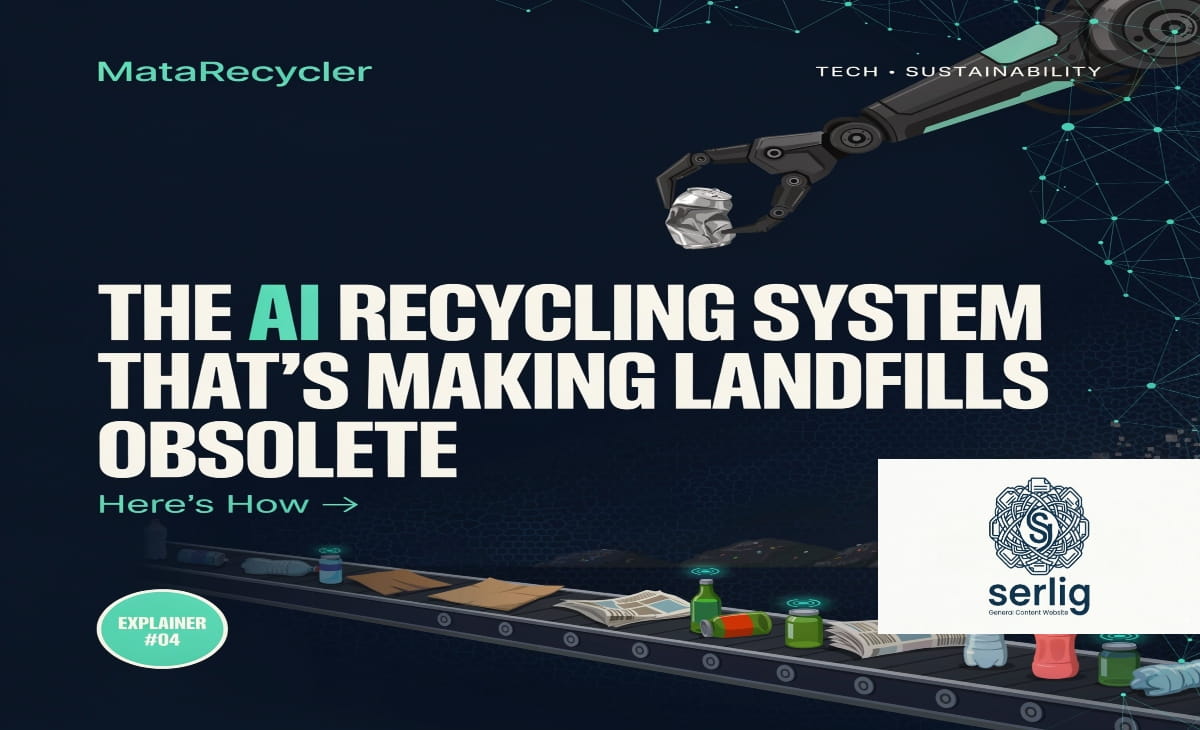
MataRecycler: The AI Recycling System That’s Making Landfills Obsolete Here’s How
The numbers hit hard. Every single day, people worldwide discard mountains of material that could re-enter supply chains as valuable resources — yet most of it never gets a second chance. The World Bank recorded global waste generation at 2.56 billion tonnes in 2022. By 2050, that figure could reach 3.86 billion tonnes if habits stay the same.
Americans alone produce roughly 292 million tons of solid waste each year — about 4.9 pounds per person per day. Of that total, only 32% actually gets recycled or composted. The rest heads to landfills, incinerators, or worse — the ocean. Studies show that 8 million metric tons of plastic enter ocean waters annually, breaking down into microplastics that poison food chains, water sources, and ecosystems.
Meanwhile, recycling facilities drown in a different problem: contamination. Recyclable materials constantly arrive mixed with non-recyclables, making entire batches unusable and worthless. Traditional systems cannot keep up.
MataRecycler exists to fix that — through artificial intelligence, smart sensors, and connected data that transforms recycling from a guessing game into a precise, measurable science.
Quick Facts Table
| Feature | Detail |
| AI Accuracy | 95%–98% material sorting accuracy |
| Smart Bins | IoT sensors monitor fill levels in real time |
| Contamination Drop | Kerbside contamination reduced from 17–25% |
| Materials Identified | 70+ recyclable material types recognized |
| Community Result | 40% more recyclables collected monthly |
| Global Waste (2022) | 2.56 billion tonnes generated worldwide |
| U.S. Recycle Rate | Only 32% of 292 million tons recycled |
| Business Savings | Landfill costs cut by 40–60% |
| Energy Feature | Solar integration in many facilities |
| Future Tech | Blockchain + predictive analytics in pipeline |
What Is MataRecycler?
MataRecycler is an intelligent recycling platform that brings together AI, Internet of Things (IoT) sensors, machine learning, and cloud-based analytics to reimagine how waste moves from bin to processing facility. Think of it not as a single product, but as a complete ecosystem — one that tracks every discarded item from the moment someone throws it away until manufacturers can reuse it.
The platform rests on a straightforward but powerful idea: every piece of waste has a material identity. Plastic, metal, paper, glass, electronics — each material belongs somewhere specific, and each carries real economic and environmental value when handled correctly. MataRecycler reads that identity, acts on it, and records it — across millions of items, every hour of every day.
Households, businesses, municipalities, and industrial facilities all have a place in the MataRecycler ecosystem. A family sorting recycling at home, a factory managing bulk waste streams, and a city government tracking district-wide performance all access the same core technology — scaled and configured to their specific needs.
How MataRecycler Works: Technology in Action
MataRecycler operates on a four-step loop: identify, sort, track, improve. Each step runs automatically, feeding the next with cleaner data and better outcomes.
AI-Powered Waste Sorting
MataRecycler’s AI sorting engine sits at the heart of the entire system. High-resolution cameras and advanced sensors scan every item placed into a smart bin. Machine learning algorithms then examine shape, color, texture, chemical composition, and density — classifying each piece within seconds and routing it to the right processing stream.
The accuracy speaks for itself. MataRecycler’s AI achieves sorting accuracy between 95% and 98%. Human sorters, by comparison, typically reach 85% to 90% on a good day — and performance drops further when volumes surge or fatigue sets in. The AI never tires, never loses focus, and grows more accurate with every batch it processes.
Contamination — the costly mixing of recyclable and non-recyclable materials — drives up costs and destroys otherwise usable resources. MataRecycler attacks this problem directly. Lower contamination means more material recovery, lower processing costs, and fewer rejected loads heading back to landfill.
Smart Bins and IoT Sensors
MataRecycler’s physical infrastructure centers on smart bins packed with IoT sensors. Each sensor tracks fill levels in real time, monitors what types of materials the bin holds, and watches environmental conditions around it. When capacity nears its limit, the system sends an automatic alert to the collection team.
Traditional waste collection runs on fixed schedules — trucks arrive daily or weekly regardless of how full or empty the bins are. Smart bins break that inefficiency completely. Collection teams dispatch trucks only when and where bins actually need emptying. Fuel consumption drops. Operational costs shrink. The carbon footprint of the entire collection process falls with them.
Cloud Analytics and Real-Time Dashboards
Every data point from every sensor across every bin flows into cloud-based dashboards that facility managers, city officials, and sustainability teams can access from anywhere in the world. These dashboards display waste patterns, recycling rates, material flows, and performance metrics — all updated continuously.
City governments gain the power to pinpoint neighborhoods with high contamination rates and target them for education campaigns. Businesses get precise, audit-ready data for ESG (environmental, social, and governance) reporting. Recycling facilities can plan smarter routes, allocate resources more effectively, and reduce guesswork entirely.
Predictive analytics go a step further, forecasting future waste volumes based on historical patterns. This helps facilities prepare for seasonal demand spikes — like the 60% increase in waste generation that some tourist destinations face during peak travel months.
The User-Facing Mobile App
MataRecycler reaches beyond industrial infrastructure and connects directly with everyday users through a clean, intuitive mobile app. Users upload details about their waste materials, receive real-time guidance on correct sorting, and track their personal recycling contributions over time.
The app closes one of the most stubborn gaps in recycling: the space between wanting to recycle and knowing how to recycle correctly. Unsure whether that plastic cup goes in the recycling bin or the general waste? The app answers immediately. Not sure how to dispose of old electronics? MataRecycler guides the user step by step. Clear guidance reduces contamination at the source — before waste even reaches a collection point.
The Environmental Impact: Why MataRecycler Matters
The environmental math behind better recycling is staggering.
Recycling aluminum uses 95% less energy than smelting it from raw bauxite ore. Each ton of recycled paper spares roughly 17 trees and 7,000 gallons of water. Recycling a single ton of plastic saves energy equivalent to 1,000–2,000 gallons of gasoline. Multiply those figures across millions of tons of material and the impact becomes transformative at a global scale.
The U.S. EPA calculated that recycling and composting activities prevented about 186 million metric tons of CO₂-equivalent emissions in 2018 alone — matching the annual emissions of 39 million cars taken completely off the road.
MataRecycler amplifies every one of these gains. Cleaner sorting means more recyclable material actually gets recovered rather than rejected. Recovered material re-enters manufacturing supply chains as a substitute for virgin resources, cutting demand for mining, logging, and petroleum extraction — all of which carry their own heavy environmental costs.
Solar integration in many MataRecycler facilities further reduces the operational carbon footprint, ensuring the system does not create new environmental burdens while solving existing ones.
Benefits for Businesses
MataRecycler makes a compelling financial case alongside its environmental one.
Landfill tipping fees across the United States have climbed 3–4% every year for the past decade, with no sign of slowing down. Companies adopting smart recycling programs have cut landfill disposal costs by 40–60%. Beyond reducing expenses, clean sorted materials can sell back into supply chains — turning what was previously a disposal cost into a revenue source.
ESG reporting grows simpler and more credible too. Investors, regulators, and consumers demand real sustainability data, not estimates. MataRecycler’s real-time reporting tools deliver precise, verifiable figures that satisfy those demands without manual data collection or guesswork.
Industries handling large volumes of specific materials — packaging, manufacturing, food service, hospitality — can customize MataRecycler to target their most valuable or problematic waste streams. One major beverage company that integrated MataRecycler into its manufacturing process hit its sustainability targets ahead of schedule, with significantly improved sorting efficiency and measurable plastic waste reduction.
Benefits for Communities and Cities
Smart cities need intelligent systems at every layer of urban life, and waste management ranks among the most visible daily services any city provides. MataRecycler slots naturally into urban infrastructure, shifting cities from reactive waste collection to proactive, data-driven resource stewardship.
One early-adopting community reported a 40% monthly increase in recyclable materials collected after switching to MataRecycler. Streets stayed cleaner. Public spaces remained fresher. Residents grew more confident about recycling because the system gave them clear, immediate feedback on their efforts.
Cities gain real-time visibility across entire districts — spotting problem areas faster, optimizing collection routes, and eliminating unnecessary truck runs. Air quality improves. Traffic disruption from waste vehicles decreases. Municipal budgets stretch further.
The economic argument deserves attention too. The U.S. recycling and reuse industry already supports 681,000 jobs and generates $37.8 billion in annual wages, according to the EPA. Higher recycling rates create direct demand for more of those roles. In areas with limited economic opportunity, smarter recycling infrastructure delivers both environmental and livelihood benefits simultaneously.
MataRecycler in Underserved Regions
MataRecycler’s potential impact extends far beyond wealthy cities with established infrastructure. Globally, only 13.5% of waste gets recycled. Across many low- and middle-income countries, that figure sits near zero. Millions of people in Southeast Asia, Sub-Saharan Africa, Latin America, and underserved U.S. communities lack even basic waste collection — let alone recycling systems.
MataRecycler addresses this gap through scalable design. Affordable smart bin technology, accessible mobile interfaces, and community-centered platform design make deployment practical in settings where traditional recycling infrastructure would never be economically viable.
Closing this gap is not only a matter of environmental justice — it is a global necessity. Waste grows fastest in the regions with the least capacity to manage it. Without intervention, that imbalance will accelerate environmental damage for the entire planet.
Challenges and the Road Ahead
MataRecycler faces real challenges that deserve honest discussion.
High upfront infrastructure costs present the biggest barrier, particularly for smaller municipalities and businesses in developing regions. Deploying networks of smart bins, sensors, and processing systems demands significant investment before the financial and environmental returns begin to show.
Behavioral change takes time too. Technology can guide people, but habits shift slowly. Communities that pair MataRecycler’s tools with active education campaigns, awareness programs, and regular feedback see the strongest results — because the platform works best when people understand why it matters.
Integrating smart systems into existing waste management frameworks adds another layer of complexity. Cities and facilities operating decades-old traditional systems face both logistical and bureaucratic hurdles. Phased rollouts and careful stakeholder engagement help, but patience remains essential.
Looking ahead, MataRecycler’s development roadmap includes predictive analytics for precise waste forecasting, blockchain integration for full supply chain transparency, and expanded residential solutions that bring smart sorting directly into the home.
The broader AI recycling market continues advancing rapidly. A January 2026 analysis by Market.us found that computer vision technology now drives over 60% of the AI-powered recycling robot market. Current AI systems recognize more than 70 recyclable material types, with a single robot capable of diverting up to 10 million items from landfills each year. MataRecycler builds on this proven and expanding foundation.
Conclusion
MataRecycler does not simply improve recycling — it redefines what recycling can accomplish. By combining AI sorting, IoT smart bins, cloud analytics, and a user-friendly mobile app into one connected system, it closes the gaps that have plagued waste management for decades: contamination, inaccuracy, inefficiency, and public disengagement.
The environmental stakes could not be higher. Every ton of material diverted from landfill saves energy, protects natural resources, and cuts greenhouse gas emissions. Every community that adopts smarter recycling practices builds a cleaner, healthier, more economically resilient future, a city that invests in intelligent waste infrastructure leads by example and earns real, measurable returns.
MataRecycler signals clearly that the future of waste management belongs to technology, data, and purpose — and that future is already here.
Don’t miss this related article on a similar topic: Labarty Explained: The AI & Tech Platform Changing How the World Learns About Digital Innovation
Frequently Asked Questions
What exactly does MataRecycler do?
MataRecycler is an AI-powered smart recycling platform that uses sensors, machine learning, and cloud analytics to identify, sort, and track waste automatically. It connects smart bins, recycling facilities, and mobile users into one integrated system that improves recycling accuracy and reduces contamination.
How accurate is MataRecycler’s AI sorting system?
MataRecycler’s AI achieves accuracy rates between 95% and 98% — significantly higher than the 85%–90% that human sorters typically manage. The system continuously improves as it processes more material, learning from every batch it handles.
Can small businesses and households use MataRecycler?
Yes. MataRecycler scales across households, small businesses, large corporations, and entire municipalities. The mobile app makes the system accessible to individual users, while the industrial platform handles high-volume commercial and city-wide deployments.
How does MataRecycler help reduce costs for businesses?
Smart recycling programs using MataRecycler have helped companies cut landfill disposal costs by 40–60%. The system also generates clean, sorted materials that businesses can sell back into supply chains, turning a disposal expense into a potential revenue source.
Is MataRecycler available in developing countries and underserved communities?
MataRecycler is designed with scalability in mind, making deployment feasible even in regions with limited existing infrastructure. Its affordable smart bin technology and accessible mobile app help bridge the recycling gap in Southeast Asia, Sub-Saharan Africa, Latin America, and underserved communities worldwide.